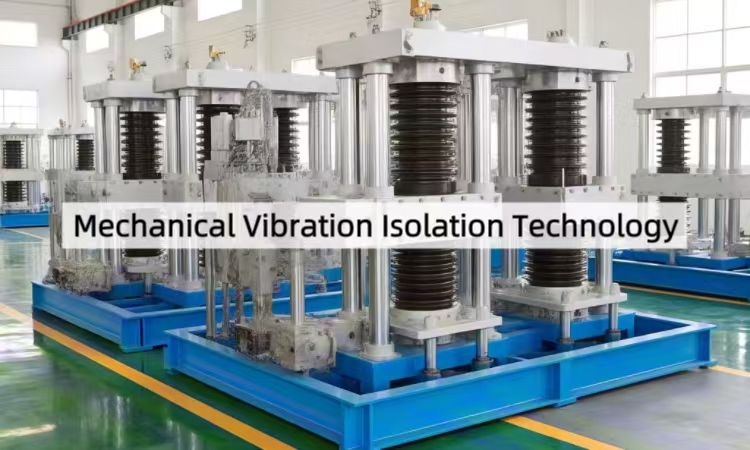
Mechanical vibration isolation technology serves as an "invisible cornerstone" for precision manufacturing, scientific research experiments, and medical equipment. By blocking or attenuating vibration transmission paths, it ensures stable operation of equipment at the nanoscale level.
Whether it's the low-temperature environment of quantum computers or the imaging accuracy of medical imaging equipment, they all rely on efficient vibration control solutions. This technology is not only related to equipment performance but also directly affects the reliability of scientific research results and the yield of industrial products.
Analysis of the Principles of Mechanical Vibration Isolation Technology
The core of vibration isolation lies in reducing the natural frequency of the system, so that the vibration frequency of the equipment is staggered with the external interference frequency. When the excitation frequency is higher than √2 times the natural frequency of the system, the vibration transmissibility decreases significantly.
For example, LeadTop's LHV series active vibration isolation module adopts an air spring + single pendulum decoupling design, which reduces the natural frequency to 0.5Hz. Coupled with six-degree-of-freedom active control, it achieves a vibration transmissibility of ≤-30dB (vibration energy attenuation of 99.9%) in the low-frequency range of 0.5-20Hz.
Its 8ms fast response and 25g impact resistance enable real-time cancellation of sudden vibrations such as elevator operation and personnel movement, ensuring a displacement accuracy of 0.1μm for superconducting magnets in quantum research.

Classification of mechanical vibration isolation technology
Passive vibration isolation relies on elastic elements such as springs and rubbers, which absorb vibration energy through material deformation and is suitable for medium-to-high frequency vibration isolation (such as in automobile engine mounts). Active vibration isolation, on the other hand, involves real-time monitoring of vibration data through sensors and the generation of counteracting forces by actuators to achieve sub-nanometer level control.
LeadTop's LHV module supports ±2μm displacement compensation and intelligently adapts to load changes ranging from 0.5 to 5 tons. It has been applied in noise isolation in acoustic laboratories (reducing background noise by 15dB) and vibration suppression in medical imaging equipment (improving MRI imaging clarity by 30%).
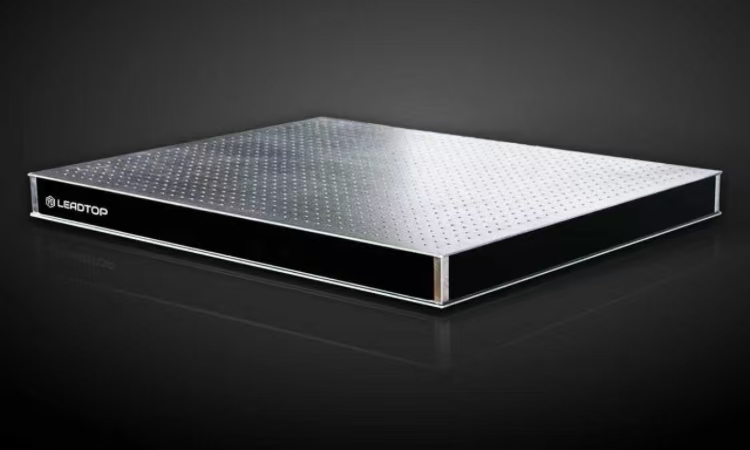
The MOT-F honeycomb core optical platform, through passive damping structures, suppresses surface resonance, with a deformation of only 0.05-0.1mm/m², making it an economical choice for optical experiments and precision testing scenarios.
Material innovation for mechanical vibration isolation
Traditional vibration isolation platforms often suffer from resonance due to their large mass and insufficient stiffness, while lightweight designs may compromise stability. The MOT-F series of LeadTop's honeycomb core optical platform baseplates utilizes a trapezoidal steel sheet bonding process to form a honeycomb-type enclosed structure, reducing mass by 30% while increasing stiffness by 40%.
Its 430 stainless steel panel is rust-resistant and easy to clean, featuring a flatness and equidistant array, with a roughness of <2µm/m², and a fully sealed hole structure to avoid welding stress, ensuring no deformation over long-term use.
Mechanical vibration isolation technology has evolved from a single component to an intelligent system, providing an "ultra-stable" environment for high-precision scenarios through the integration of passive and active technologies and innovations in material structures. Cutting-edge practices from brands such as LeadTop are driving industrial and scientific research towards greater precision and reliability, making it an indispensable core technology in the era of intelligent manufacturing.


