Vibration reduction and isolation are the two core technologies in the field of vibration control. Although both aim to reduce the impact of vibration, there are essential differences in technical principles, application scenarios, and implementation methods.
This article will analyze from three dimensions: technical definition, mechanism of action, and typical scenarios, and combine the application case of LeadTop isolation optical platform to reveal the core differences between the two.
Technical definition of vibration reduction and isolation: energy consumption and propagation blockage
Vibration reduction converts vibration energy into thermal energy consumption through damping materials or structures, essentially "energy absorption". For example, car shock absorbers use hydraulic damping to suppress spring rebound, which belongs to passive energy dissipation.
Vibration isolation is achieved by blocking the propagation path of vibration through elastic support or active control systems, essentially "energy isolation". LeadTop's active isolation platform uses six degrees of freedom sensors and intelligent actuators to counteract environmental vibrations in real time and achieve active blocking of vibration propagation.
The mechanism of vibration reduction and isolation: dynamic response and static isolation
Vibration reduction technology focuses on dynamic vibration control, such as bridge tuned mass dampers (TMDs) that transfer vibration energy through additional mass blocks and are suitable for frequency stable vibration sources.
Vibration isolation technology focuses more on static or quasi-static isolation. For example, in the installation of precision instruments, LeadTop's honeycomb core optical platform MOT-F series attenuates ground vibrations by more than 95% through a multi-layer composite structure, ensuring the stability of the experimental environment.
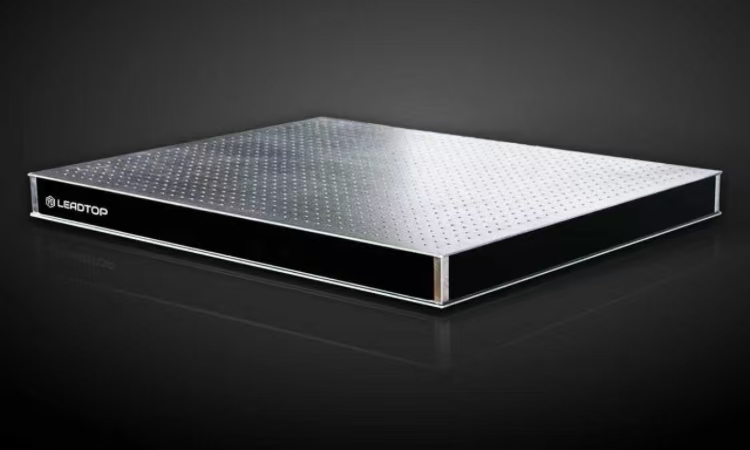
Typical scenario: Engineering protection and precision manufacturing
Vibration reduction technology is widely used in the field of engineering protection. Vibration isolation technology is the core support of precision manufacturing. LeadTop's customized heavy-duty platform MOT-Z series for the semiconductor industry uses a nonlinear vibration isolation system to cope with wideband excitation, increasing the resolution rate of lithography machine vibration problems by 20% and significantly improving product yield.

Vibration reduction and isolation are like the "spear" and "shield" of vibration control. The former uses energy consumption to cope with dynamic impacts, while the latter uses propagation blocking to ensure static stability. The LeadTop vibration isolation optical platform combines the advantages of active and passive composite technology, providing a full scene vibration control solution for fields such as quantum technology and nanomanufacturing.


