In high-precision fields such as aerospace and biomedical engineering, equipment sensitivity to environmental vibrations has reached the nanometer level. Traditional isolation solutions increasingly reveal limitations due to issues like heavy mass and narrow frequency bandwidth. Honeycomb vibration isolation technology, leveraging its unique biomimetic structure and material innovations, emerges as a key breakthrough in achieving the balance between “lightweight” and “high damping.”
Design Logic of Honeycomb Vibration Isolation: The “Mechanical Wisdom” of Bionic Honeycombs
The core of honeycomb vibration isolation lies in the engineered application of nature's hexagonal structure. By constructing the interior of the mounting plate as densely arranged hollow honeycomb cells, it achieves lightweighting through “replacing solid with void” via geometric stability. Simultaneously, the thin-plate bending effect of the honeycomb walls disperses stress, enhancing overall stiffness.
This design inherently filters low-frequency vibrations. When combined with broadband damping materials filling the honeycomb voids, it further converts vibrational energy into dissipated heat, achieving comprehensive attenuation across the 1Hz to 1kHz frequency range.
LeadTop's MOT-F honeycomb core optical platform base innovatively employs a trapezoidal thin steel plate sandwich bonding process. By optimizing the honeycomb cell angle and wall thickness, it maintains the base's load-bearing capacity while compressing the resonance frequency below 65Hz, significantly reducing vibration-induced aberrations in optical systems.
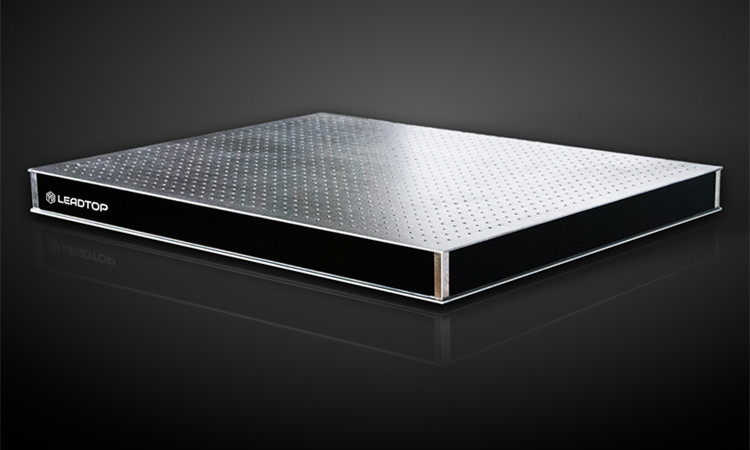
Performance Breakthroughs in Honeycomb Isolation: Three Key Metrics Reveal Generational Advancements
The advantages of honeycomb isolation technology are quantified through three critical metrics:
Evolutionary Scenarios for Honeycomb Isolation: Universal Path from Lab to Industry
Honeycomb isolation technology is transcending traditional optical applications to penetrate more high-precision scenarios:
From natural inspiration to engineering revolution, honeycomb isolation technology redefines the stability boundaries of precision equipment through its “lightweight-toughness synergy” design philosophy. Companies like LeadTop are advancing this technology toward higher frequencies and larger dimensions through continuous innovation in materials science and manufacturing processes, providing core support for future industries such as nanomanufacturing and deep space exploration.


