
The Vibration-Damping Essence of Rubber Pads: Energy Dissipation and Dynamic Equilibrium
The core function of rubber vibration isolation pads lies in converting mechanical vibration kinetic energy into thermal energy through molecular friction and deformation within the material, rapidly dissipating it to block vibration transmission pathways. Their damping efficiency depends on rubber hardness, loss factor (damping performance), and structural design.
POT-X Series: The Technical Benchmark for Creep Resistance and Multi-Frequency Adaptability
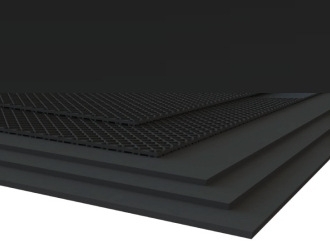
LeadTop's independently developed POT-X series rubber vibration isolation pads utilize a triple-reinforced formulation of “composite rubber + polyester fiber + graphite,” significantly enhancing material creep resistance and temperature tolerance.
This series supports single-layer or multi-layer configurations. By adjusting the interlayer stiffness ratio, it precisely reduces system natural frequencies to 6.5Hz vertically and 2Hz horizontally, making it particularly suitable for primary vibration isolation in medium-to-large equipment like stamping machines and air compressors.
Sound Insulation Performance of Rubber Isolation Pads
The sound insulation capability of rubber vibration isolation pads stems from two primary mechanisms: First, the material's inherent damping properties attenuate acoustic vibration energy. Second, structural mass enhancement increases sound transmission loss. The POT-X series employs an “alternating soft-hard layer” design, maintaining elasticity while increasing surface density. This achieves noise attenuation of 8-15dB across the 125-4000Hz frequency range.
Long-Term Stability of Rubber Isolation and Soundproofing Pads
Addressing the aging and creep issues common in traditional rubber pads, the POT-X series employs graphite particle filling technology to optimize molecular chain structure. This controls the one-year creep rate below 21.5% and projects a 10-year creep rate of only 35.6%, extending service life beyond 12 years. Its dynamic damping ratio (0.05–0.2) adapts to equipment load variations, preventing secondary vibrations caused by sudden stiffness changes.
As industrial equipment evolves toward higher precision and heavier loads, rubber vibration isolation pads are upgrading from “passive damping” to “active tuning.” LeadTop's next-generation products will integrate piezoelectric sensors with adaptive stiffness adjustment modules to achieve real-time matching of vibration frequencies, safeguarding the stable operation of every piece of equipment.


