Isolation Platform Principles: Base Plate Design as the Cornerstone of Optical Platform Physical Stability
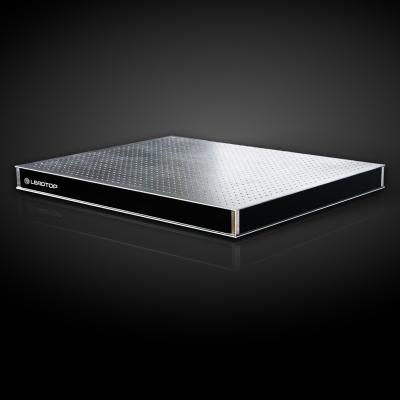
The core of isolation platforms lies in the synergy between base plate structures and isolation devices to block environmental vibrations from interfering with precision equipment. LeadTop's MOT-F Series Honeycomb Core Optical Platform Base employs a composite design featuring a 430 stainless steel top plate and a trapezoidal thin steel honeycomb core panel. The lightweight honeycomb structure and its broadband damping properties effectively suppress surface resonance.
This design rapidly dissipates vibration energy within the honeycomb structure. Combined with a fully sealed, weld-hole-free construction, it prevents long-term deformation caused by stress release in traditional platforms, providing a stable physical foundation for optical experiments, precision inspection, and similar applications.
Control Logic of Isolation Platform Principles: From Passive Damping to Active Control
Isolation platform logic falls into two categories: passive and active. Passive isolation relies on material damping (such as the honeycomb core panels in the MOT-F series) and the elastic deformation of air springs to achieve fundamental isolation by attenuating high-frequency vibrations. Active isolation, however, employs sensors to monitor vibration signals in real time, driving electromagnetic actuators to provide counteracting compensation.
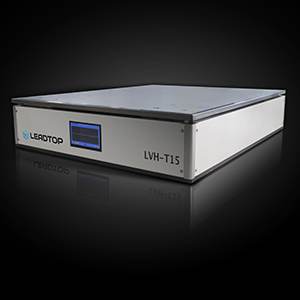
For instance, LeadTop's LVH-T15 heavy-duty active isolation platform employs a composite technology of four-stage air springs and electromagnetic actuators. It provides six-degree-of-freedom suppression across the full 1-200Hz frequency range, achieving over 90% attenuation efficiency for low-frequency building sway disturbances (e.g., subway operation, pedestrian movement) between 0.5-5Hz. Step disturbance suppression is accomplished within 30ms.
LeadTop's Solutions: Practical Application of Contextualized Isolation Platform Principles
LeadTop offers differentiated products tailored to diverse precision equipment requirements. The MOT-F series platform, featuring low surface roughness (<2μm/m²) and deformation resistance of 0.05-0.1mm/m², serves as an ideal carrier for laser interferometers, microscopes, and similar instruments.
The LVH-T15 platform is specifically engineered for TEM/SEM applications. Its 500kg load capacity and online modal analysis functionality significantly enhance cryo-EM resolution and FIB beam stability. With low-frequency attenuation exceeding 35dB@5Hz, it demonstrates irreplaceable advantages in heavy-duty scenarios like semiconductor inspection and life sciences.
From baseplate materials to active control technologies, vibration isolation platforms fundamentally operate through the tripartite synergy of “structure-energy-control.” LeadTop delivers comprehensive solutions for precision equipment—from foundational support to dynamic compensation—through passive damping optimization in the MOT-F series baseplates and active full-band suppression in the LVH-T15 platform. This establishes LeadTop as a critical enabler for stable operation across optical, electron microscopy, semiconductor, and other fields.


