Introduction: Vibration - the invisible killer of precision experiments
In today's rapidly advancing technology, precision instruments and experimental equipment have become the core driving force for scientific research innovation and industrial upgrading. However, vibration, as an invisible 'enemy', constantly threatens the accuracy of experiments. Weak ground vibrations, the operation of nearby equipment, and even disturbances caused by personnel movement can all have a fatal impact on high-precision experiments.
According to statistics, over 60% of precision experimental errors come from environmental vibration interference. Among numerous solutions, the isolation table has become the preferred tool for protecting precision equipment from vibration interference due to its high efficiency and reliability.
This article will provide an in-depth analysis of the technical principles, classification, performance comparison, and purchasing recommendations of vibration isolation tables, helping readers to comprehensively understand and choose the most suitable vibration isolation solution.
1、 Working principle of isolation table: technological evolution from passive isolation to active compensation
1.1 Passive Vibration Isolation: The Scientific Principle of Basic Vibration Isolation
Passive isolation table is the most traditional isolation technology, and its core principle is based on the classical spring mass system theory. When external vibrations are transmitted to the isolation table, elastic elements (such as rubber and springs) deform and absorb vibration energy, while the platform surface remains relatively stable due to inertia.
The performance of a passive isolation table is mainly determined by its natural frequency, and the lower the natural frequency, the better the isolation effect. For example, the POT-P series solid-state isolation optical platform has a vertical/horizontal natural frequency of 6.5~12Hz, which can meet the isolation requirements of general precision instruments.
Advantages and limitations: The passive isolation table has a simple structure, does not require external energy, and has low maintenance costs. However, its isolation frequency band is limited, and its isolation effect on ultra-low frequency vibrations (<5Hz) is poor, making it suitable for conventional application scenarios with moderate vibration requirements.

1.2 Air floating vibration isolation: the ultra-low frequency advantage of air springs
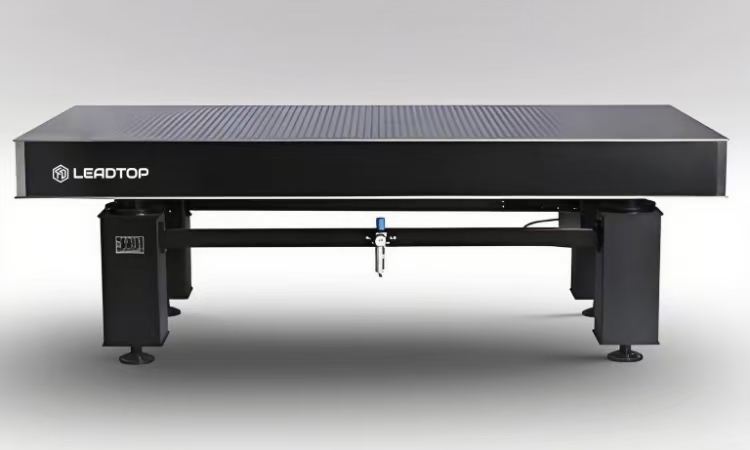
The air flotation isolation platform utilizes compressed air to form elastic support, achieving a lower natural frequency than passive methods, making it an ideal choice for ultra-high precision experiments.
Furthermore, the ZDT-B series air floating pendulum type isolation platform adds a pendulum structure to the traditional air floating foundation, utilizing the principle of a single pendulum to further reduce the horizontal natural frequency to 1.0-1.5Hz (vertical 1.0-2.0Hz), with an isolation efficiency of 86-99% (5-10Hz), providing excellent assurance for ultra-high precision experiments.
Supporting system: The modern air flotation isolation platform is equipped with a silent air compressor (<50dB) and an automatic leveling system, with a leveling accuracy of ± 0.1mm, ensuring that the platform is always in ideal working condition.
1.3 Active Vibration Isolation: The pinnacle of intelligent vibration compensation technology
The active isolation platform represents the highest level of isolation technology, achieving intelligent vibration compensation through a closed-loop system of sensors, controllers, and actuators. High precision piezoelectric sensors monitor the real-time vibration status of the platform (capable of detecting nanoscale displacement changes), and the control system calculates compensation force through advanced algorithms to drive the actuator to generate reverse vibration for cancellation.
1.4 Hybrid Vibration Isolation: Perfect Integration of Active and Passive Technologies
The hybrid isolation platform combines the advantages of active and passive technologies, with the passive layer providing basic isolation and the active layer providing fine compensation, achieving a good balance between performance and cost.
2、 Comparison of Technical Performance and Selection Suggestions for Vibration Isolation Stations
2.1 Technical Performance Comparison
Passive isolation table: simple structure, low cost, but limited isolation frequency band, suitable for mid frequency vibration isolation.
Air floating vibration isolation table: With low natural frequency and good isolation effect, it is especially suitable for ultra-low frequency vibration isolation, but it requires a matching gas source system, which is costly.
Active isolation table: Excellent isolation performance, fast response speed, rich intelligent functions, but expensive and complex maintenance.
Hybrid isolation table: Combining the advantages of active and passive technology, balancing performance and cost, suitable for scenarios with extremely high requirements for vibration control.
2.2 Selection Suggestions
2.2.1 Load requirements
The selection of isolation table and the determination of load requirements are the primary key. The requirements for the isolation table vary greatly depending on the load situation.
The load is roughly divided into light, medium, and heavy according to weight. When selecting an isolation platform for light loads of 150kg or less, it is important to ensure that it can easily support and effectively isolate vibrations to meet the operational needs of lightweight equipment.
The weight of medium-sized loads ranges from 150kg to 300kg, and these types of loads are commonly used in various scenarios. The selected isolation platform should not only be able to bear the load, but also have good isolation performance to ensure equipment stability.
Heavy loads exceeding 300kg require extremely high load-bearing capacity for the isolation platform. It is necessary to choose a heavy-duty vibration isolation platform that can withstand huge weights, provide strong vibration isolation, and ensure the safe operation of heavy equipment.
2.2.2 Vibration frequency band
Different devices have varying sensitivities to vibration frequency bands. Semiconductor devices typically focus on the 1-100Hz frequency band, while optical interferometers need to suppress vibrations below 0.5Hz. Therefore, when selecting an isolation table, it is necessary to ensure that it can effectively isolate vibrations within the target frequency band.
2.2.3 Installation Environment
Consider the spatial conditions, gas supply, and cleanliness requirements of the installation environment. When space is limited, a compact table type vibration isolation table should be chosen; If there is no gas source environment, a passive isolation table should be selected; Clean room environments should choose products with sealed designs.
2.2.4 Budget Cost
The active vibration isolation table has the highest price, followed by the air floating type, and the passive type has the lowest price. In the case of limited budget, it is necessary to comprehensively consider the initial investment and long-term operating costs, and choose the most cost-effective solution.
2.2.5 Maintenance Requirements
Evaluate the technical strength and operational budget of the laboratory. Active vibration isolation stations require regular calibration and software updates, while air flotation systems require maintenance of the gas source system, while passive ones require almost no maintenance. Choose the appropriate type of isolation table based on the actual situation to reduce maintenance costs and difficulty.
Conclusion: Choosing a professional isolation platform to achieve outstanding scientific research
As a key tool for protecting precision equipment from vibration interference, the technical selection of the isolation table directly affects the accuracy and reliability of the experiment.
This article provides an in-depth analysis of the working principle, technical classification, performance comparison, and selection suggestions of vibration isolation tables, aiming to help readers comprehensively understand and choose the most suitable vibration isolation scheme.
In the actual purchasing process, it is recommended that users fully consider factors such as load requirements, vibration frequency bands, installation environment, budget costs, and maintenance needs, and consult professional suppliers for technical support if necessary.
Choosing a professional and reliable vibration isolation platform will safeguard precision experiments and promote continuous breakthroughs and achievements in scientific research.


