Introduction: You may have misunderstood about passive vibration isolation
In the field of precision instruments, passive vibration isolation is a high-frequency term, but many people have misconceptions about it. Some people think that the more expensive the better, some believe that installation is a one-time solution, and some confuse active vibration isolation with passive vibration isolation. This article will unveil the mystery of passive vibration isolation, correct common misconceptions, and help you establish a correct understanding.
1、 The essential difference between passive vibration isolation and active vibration isolation
The passive vibration isolation system relies entirely on mechanical structures to achieve vibration attenuation, without the need for external energy sources. It utilizes the physical properties of elastic elements (rubber, air springs) and damping materials to absorb and convert vibration energy into thermal energy for dissipation. The entire process is passive and automatic.
Active vibration isolation requires an external power source to drive, and real-time detection of vibration is achieved through sensors. Then, the controller drives the actuator to generate reverse vibration to counteract interference. Although the performance is superior, the structure is complex and the cost is high.
Passive vibration isolation is suitable for medium to high frequency vibration environments (above 5Hz), with a simple structure, easy maintenance, and low cost, making it the preferred choice for most laboratories. Active isolation is designed for ultra-low frequency vibrations (1-5Hz) and is suitable for devices such as transmission electron microscopes that are extremely sensitive to vibrations.
The purchase cost of passive vibration isolation platforms is usually 1/3 to 1/2 of that of active systems, and there is no need for electricity consumption. In terms of maintenance, the rubber platform only requires regular replacement of elastic components (2-3 years), while the air flotation platform requires maintenance of the air circuit system, with overall maintenance costs much lower than active vibration isolation.
2、 Five common misconceptions about passive vibration isolation
Misconception 1: The higher the price, the better the effect
This is the most common misunderstanding. The passive vibration isolation effect depends on core parameters such as natural frequency and transmission rate, rather than price. If the laboratory vibration source is mainly above 20Hz, choosing a rubber platform with a natural frequency of 4-8Hz is sufficient, and purchasing a 1-2Hz air flotation platform is a waste of performance.
The correct approach is to first conduct vibration testing to determine the frequency of the main vibration source, and then select a passive vibration isolation platform with a natural frequency lower than 1/√ 2 times the frequency of the vibration source. This can meet the requirements and save costs.
Misconception 2: No maintenance required after installation
Many people believe that the installation of passive vibration isolation platforms is a one-time solution, but this is incorrect. Rubber materials will age over time and their elasticity will decrease; The air path of the air flotation system may leak; The leveling accuracy may shift due to changes in load.
It is recommended to check the platform levelness every six months, conduct a comprehensive calibration once a year, and replace rubber components every 2-3 years. Regular maintenance can ensure that the passive vibration isolation system is always in optimal working condition.
Misconception 3: It can be installed on any ground
Passive vibration isolation platforms have clear requirements for installation foundations. Uneven ground can cause uneven stress on the platform, affecting the isolation effect; Insufficient ground strength may cause resonance amplification. The ideal foundation should be flat and sturdy, with a flatness of ≤ 0.05mm/m.
For the air flotation system, a stable compressed air source (0.2-0.4MPa) should also be equipped, and the air path should be dry and clean. The basic assessment before installation cannot be ignored.
Misconception 4: Vibration isolation platform can isolate all vibrations
Passive vibration isolation systems have a frequency response range and typically have good attenuation effects on vibrations above the natural frequency √ 2 times, but may amplify vibrations below this frequency. That's why choosing the appropriate natural frequency is so important.
In addition, passive vibration isolation mainly isolates vibrations transmitted from the ground, and is powerless against airborne sound wave vibrations, thermal deformations caused by temperature changes, etc. It needs to be comprehensively addressed in conjunction with other measures.
Misconception 5: One platform is universal for all devices
The requirements for passive vibration isolation vary significantly among different devices. Electron microscopes require ultra-low frequency isolation, spectrometers focus on mid frequency stability, and laser systems are sensitive to high-frequency vibrations. Using the same platform to host all devices may result in some devices not being able to fully utilize their performance.
It is recommended to choose a dedicated platform based on the characteristics of the equipment, or adopt modular design to configure modules with different isolation parameters for different devices.
3、 Interpretation of Core Parameters for Passive Vibration Isolation
The natural frequency is the most important parameter of the passive vibration isolation platform, which determines the low-frequency isolation capability. Generally speaking:
Air flotation platform: 1-2Hz (ultra-low frequency)
Rubber platform: 4-12Hz (mid low frequency)
Rigid support:>15Hz (high frequency)
The lower the natural frequency, the better the low-frequency isolation effect, but the higher the cost.
Transmittance describes the degree of attenuation of vibration after passing through a passive vibration isolation system, usually expressed in decibels (dB). -20dB indicates vibration attenuation to 1/10 of its original level, while -40dB indicates attenuation to 1/100. The transmission rate of high-quality platforms should be ≤ -20dB at 5Hz and ≤ -30dB at 10Hz.
Load stability includes flatness, leveling accuracy, and long-term deformation. Flatness reflects the flatness of the tabletop, and high-quality passive vibration isolation platforms can reach 0.05mm/m; The leveling accuracy reflects the system's compensation capability and should be controlled within ± 0.1mm; The long-term deformation is related to the service life, and the honeycomb core structure can control the deformation within 0.05-0.1mm/m ².
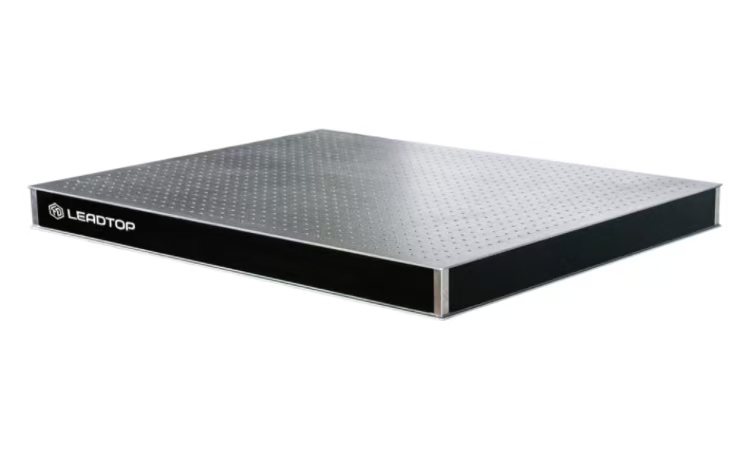
LeadTop's honeycomb core optical platform MOT-F series flat equidistant array has a roughness of<2 µ m/m ² and a deformation of 0.05-0.1mm/m ². It is suitable for optical experiments, precision testing, and other scenarios that require high stability.
4、 How to determine whether the passive vibration isolation effect meets the standard
For devices such as optical microscopes, image stability can be directly observed. If the image is clear, without shaking, and there is no drift after long-term observation, it indicates that the passive vibration isolation effect is good. On the contrary, if the image is blurry, has ghosting, or frequently loses focus, it may be necessary to check the isolation system.
Conduct the same experiment or measurement to compare the repeatability of data before and after using a passive vibration isolation platform. If the standard deviation significantly decreases and the measurement uncertainty decreases, it indicates that the isolation effect is significant.
Measure the vibration spectrum of the equipment table using a vibration sensor and compare it with before isolation. In an ideal situation, the amplitude of the main vibration peak should be reduced by more than 20dB.
Conclusion: Scientific cognition maximizes the value of passive vibration isolation
Passive vibration isolation is an important guarantee for the stable operation of precision instruments, but its maximum value can only be realized by correctly understanding its principles, avoiding common misconceptions, and selecting appropriate solutions. I hope this article can help you establish a scientific understanding of passive vibration isolation and provide solid support for successful experiments.
Remember, the most suitable passive vibration isolation solution is not the most expensive, but the one that best meets your actual needs. Choosing a professional supplier such as LeadTop to receive technical support and after-sales service will ensure the long-term stable operation of your vibration isolation system.


