The Core Principle of Vibration Isolation in Isolators: Breaking the Vibration Transmission Chain
As elastic components connecting equipment to foundations, isolators fundamentally function by reconfiguring vibration transmission paths. They transform rigid connections into elastic ones, thereby reducing or eliminating bidirectional vibration energy transfer between equipment and foundations. Their essence lies in physically achieving the “isolation” and “attenuation” of vibration energy.
Frequency Separation Principle: The Mathematical Code of Isolation Effectiveness
The key to isolation effectiveness lies in matching the system's natural frequency with the excitation frequency. When the ratio of excitation frequency (f) to isolator natural frequency (f₀) (λ = f/f₀) exceeds √2, the vibration transmission rate (T) becomes less than 1, indicating the isolator begins to function.
For example, LeadTop's ZDT-B series pendulum-type air-bearing isolators optimize their horizontal natural frequency to 1.0-1.5Hz through a single-pendulum structure, achieving 88%-94% isolation efficiency at the 5Hz frequency band—a classic application of the frequency separation principle.
Energy Conversion Mechanism: Transformation from Vibration to Thermal Energy
Vibration isolators dissipate vibrational energy through two mechanisms: first, utilizing the energy storage properties of elastic materials' deformation, such as the shear deformation in rubber isolators; second, converting kinetic energy into thermal energy via damping elements.
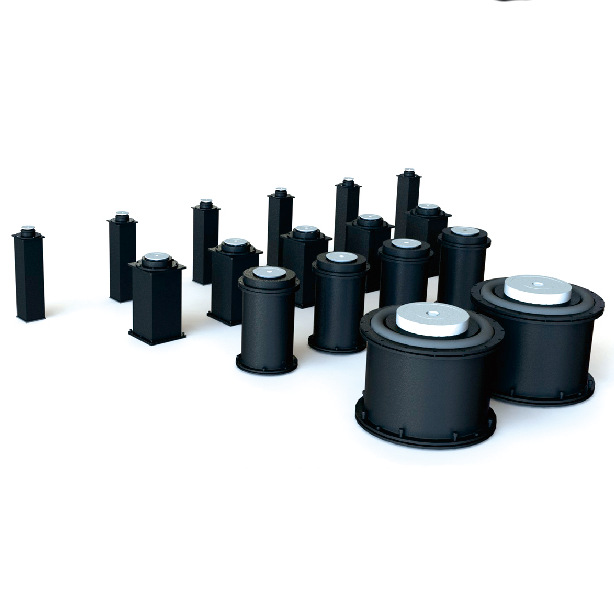
Take LeadTop's POT-P series solid rubber isolators as an example. Their composite rubber structure achieves natural frequencies of 6.5-12Hz vertically and 3-8Hz horizontally. Through internal material friction, they dissipate medium-to-high frequency vibration energy as heat with a recovery time <5 seconds, meeting the rapid stabilization demands of equipment like microscopes.

The Technical Dynamics Between Active and Passive Isolation
Passive isolators rely on material properties for vibration isolation, offering advantages like simple structure and low cost. However, they struggle with low-frequency vibrations (<5Hz). Active isolation systems, in contrast, use sensors to monitor vibrations in real time, driving actuators to generate counter-vibrations for cancellation.
LeadTop's active vibration isolation optical platform employs closed-loop control algorithms to maintain vibration transmission rates below 5%. This makes it particularly suitable for ultra-precision applications like semiconductor manufacturing, demonstrating the innovative value of technological integration.


