The Core Significance of Machine Vibration Control
Machine vibration control employs technical measures to reduce abnormal vibrations during equipment operation, directly impacting machining precision, equipment lifespan, and production environment safety. In CNC machine tools, semiconductor manufacturing, and medical imaging equipment, vibration control failure can increase product scrap rates by over 30%, becoming a critical bottleneck in industrial upgrading.
Passive Damping Machine Vibration Control: Dual Optimization of Materials and Structure
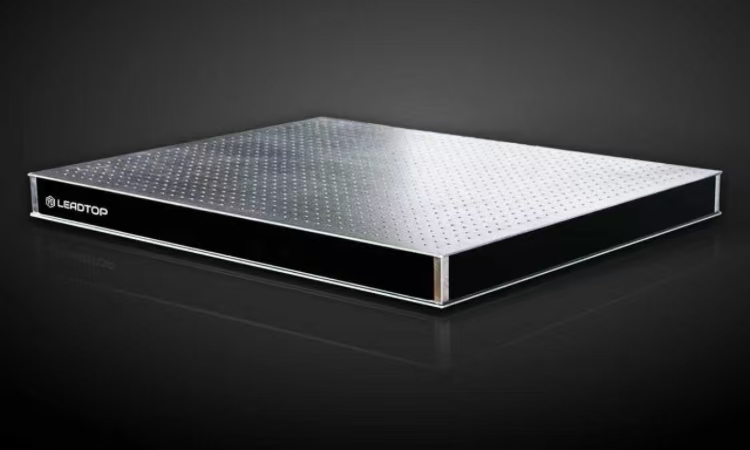
Passive machine vibration control relies on damping materials or structural deformation to absorb vibrational energy. For instance, the MOT-F series honeycomb-core optical platform base employs trapezoidal thin steel plates laminated into honeycomb core panels.
This design reduces mass while enhancing rigidity, effectively suppressing surface resonance. Through a fully sealed honeycomb structure design that eliminates welding stresses, this product maintains long-term deformation within 0.05mm/m², making it suitable for high-stability applications like optical experiments.
Active Intelligent Machine Vibration Control: Six-Degree-of-Freedom Precision Regulation
Active control achieves dynamic compensation through sensor-actuator coordination. LeadTop's LHV series active vibration isolation modules employ an air spring + pendulum decoupling design combined with a six-degree-of-freedom precision algorithm.
They respond to vibration changes within 8ms, achieving a low-frequency vibration transmission rate of ≤-30dB at 0.5-20Hz. Its intelligent load adaptation function (0.5-5 tons) automatically adjusts compensation parameters, ensuring nanometer-level operational precision for quantum research equipment.

Scenario-Based Applications in Machine Vibration Control: LeadTop's Industry Solutions
For low-frequency noise interference in acoustic laboratories, LHV modules reduce background vibration below 0.1μm through ±2μm displacement compensation technology. In medical imaging equipment, their 25g shock resistance effectively isolates vibration damage during transport. After implementing this solution, a tertiary hospital achieved a 40% improvement in MRI imaging clarity, validating the technology's practical value.
Machine vibration control is evolving from “single passive” to integrated “passive + active + intelligent” systems. Brands like LeadTop are advancing control precision into the nanometer era through material innovation and algorithmic breakthroughs. Looking ahead, with the widespread adoption of 5G and industrial internet, real-time remote vibration monitoring systems may become standard equipment in smart factories.


