With the development of the manufacturing industry in the direction of high-end, intelligent, and precision, vibration control problems in the production process are becoming increasingly prominent. In the field of precision manufacturing, even the slightest vibration may lead to problems such as product defects, equipment wear, and accuracy decline. As an effective vibration control method, vibration isolation devices are playing an increasingly important role in precision manufacturing. This article will discuss the importance of vibration isolation devices in precision manufacturing and their future application prospects.
Stringent Requirements for Vibration Control in Precision Manufacturing
Precision manufacturing covers multiple fields such as semiconductor manufacturing, optical processing, microelectronics assembly, and precision machining. A common feature of these fields is: extremely high requirements for the stability of the production environment. In the semiconductor lithography process, the alignment accuracy of silicon wafers is required to reach the nanometer level, and any tiny vibration may cause circuit pattern deviation, resulting in chip scrapping.
In optical component processing, the surface accuracy of parts such as lenses and prisms directly affects the performance of optical systems. Vibration during processing will leave tiny lines on the surface of the component, affecting the transmission and refraction of light, and reducing the imaging quality of the optical system. Therefore, optical processing equipment must be equipped with high-performance vibration isolation devices to ensure the stability of the processing process.
Microelectronics assembly is also sensitive to vibration. In processes such as placement, welding, and inspection, precise positioning and alignment are prerequisites for quality assurance. Vibration will cause problems such as component position deviation, poor solder joints, and inspection errors, seriously affecting product reliability and production efficiency.
Technical Principles and Classification of Vibration Isolation Devices
The technical principle of vibration isolation devices is based on vibration isolation theory. When vibration is transmitted from the vibration source to the equipment, the vibration isolation device attenuates the vibration energy through the action of elastic elements and damping elements, reducing the vibration amplitude transmitted to the equipment. According to different vibration isolation methods, vibration isolation devices can be divided into two categories: passive vibration isolation and active vibration isolation.
Passive vibration isolation devices use the physical characteristics of elastic materials such as springs, rubber, and airbags to achieve vibration isolation. They have simple structure, low cost, and convenient maintenance, and are suitable for most conventional applications. Active vibration isolation devices use a closed-loop system composed of sensors, controllers, and actuators to detect and cancel vibrations in real time. The vibration isolation effect is better, but the system is complex and costly, and is mainly used in occasions with extremely high requirements for vibration isolation.
In addition, according to different vibration isolation frequency ranges, vibration isolation devices can also be divided into low-frequency vibration isolation devices, medium-frequency vibration isolation devices, and high-frequency vibration isolation devices. Vibration isolation devices in different frequency ranges have different structural designs, material selections, performance indicators, etc., which need to be selected according to specific applications.
Application of LeadTop High-Performance Vibration Isolation Devices in Precision Manufacturing
In the field of precision manufacturing, LeadTop provides a variety of high-performance vibration isolation device products that can meet the vibration isolation needs of different process links. LeadTop's pendulum air-flotation vibration isolator ZDT-B series adopts ultra-thin composite airbags and pendulum principle structure, with horizontal natural frequency as low as 1.0-1.5Hz and vertical natural frequency as low as 1.0-2.0Hz. At 5Hz frequency, the vibration isolation efficiency reaches 86-94%, which can effectively isolate external vibration interference and ensure the stable operation of precision manufacturing equipment.
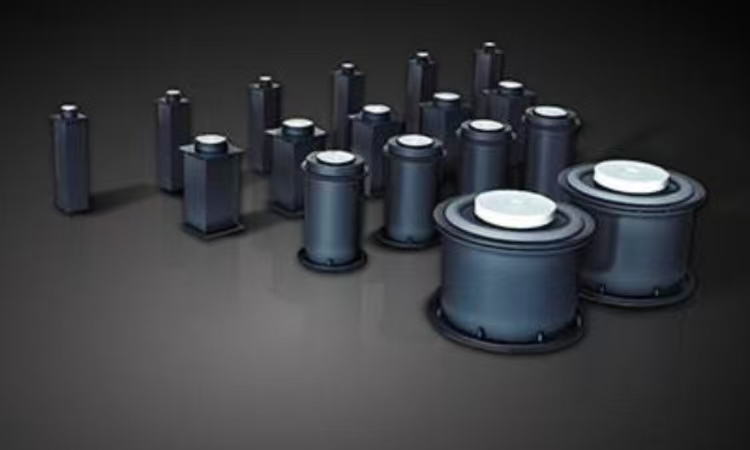
For application scenarios with relatively low vibration requirements, LeadTop's solid rubber vibration isolator POT-P series is an ideal choice. This series of products adopts a combined rubber structure with excellent horizontal vibration isolation performance, vertical natural frequency 6.5-12Hz, horizontal natural frequency 3-8Hz, single load covering 180-800kg, stable structure, convenient installation, equipped with lifting adjustment seat for precise leveling, suitable for precision manufacturing related fields such as microscope inspection and biomedical equipment.

Application Prospects and Development Trends of Vibration Isolation Devices
With the continuous advancement of precision manufacturing technology, the application prospects of vibration isolation devices are very broad. On the one hand, manufacturing accuracy requirements continue to increase, promoting the development of vibration isolation devices in the direction of higher performance. In the future, the natural frequency of vibration isolation devices will be lower, the vibration isolation efficiency will be higher, and the environmental adaptability will be stronger.
On the other hand, the rise of smart manufacturing has also brought new development opportunities for vibration isolation devices. Intelligent vibration isolation devices can monitor vibration status in real time, automatically adjust vibration isolation parameters, and predict maintenance needs, greatly improving the reliability and maintenance convenience of vibration isolation systems. LeadTop is actively investing in the research and development of intelligent vibration isolation technology, committed to providing users with more intelligent and efficient vibration isolation solutions.
In addition, concepts such as green manufacturing and sustainable development also affect the development of vibration isolation devices. Environmentally friendly materials, energy-saving design, long life, etc. have become new development directions for vibration isolation devices. In the future, vibration isolation devices must not only meet the needs of precision manufacturing in terms of performance, but also meet higher requirements in terms of environmental protection and energy saving.
Summary
Vibration isolation devices play an irreplaceable and important role in precision manufacturing. By effectively isolating vibration interference, vibration isolation devices can ensure the stable operation of production equipment, improve product quality, and extend equipment life. With the continuous development of the manufacturing industry, the technical level and application scope of vibration isolation devices will continue to improve. As a professional vibration isolation device supplier, LeadTop will continue to uphold the concept of technological innovation and quality-oriented, and provide more high-quality and efficient vibration isolation products and services for the precision manufacturing industry.


