The electron microscope stands as the ultimate observation tool in modern scientific research—from atomic-level imaging with transmission electron microscopes (TEM) to surface morphology analysis with scanning electron microscopes (SEM), its precision rests entirely on mechanical stability at the nanometer and even sub-nanometer scale. Yet the building micro-vibrations and random electromechanical disturbances present in the operating environment of electron microscopes constitute the single greatest threat to that stability.
Vibration isolation for electron microscopes is precisely the solution: through precisely engineered active isolation systems, the impact of external vibration on electron microscopy imaging is minimized to the greatest degree possible. This article systematically examines the physical principles, key technical pathways, and latest engineering breakthroughs of vibration isolation for electron microscopes, offering electron microscopy users and laboratory planners a comprehensive and in-depth technical reference.
The extreme sensitivity of electron microscopes to vibration stems fundamentally from their extreme working scale. A typical transmission electron microscope must focus its electron beam to the sub-angstrom level (below 0.1 nm) and stably scan or illuminate a specified position on the sample surface. At this scale, even the most minute vibrational disturbance from the external environment—such as micro-tremors from air conditioning ducts several floors above, low-frequency ground waves excited by a passing metro hundreds of meters away, or footstep vibrations generated by laboratory personnel walking nearby—can, after transmission and amplification through the building structure, manifest as displacements of several nanometers within the microscope sample chamber.
For routine SEM imaging, 5–10 nm of vibration is already sufficient to produce visually discernible jagged motion blur in high-magnification images. For atomic-resolution TEM imaging, vibrations of merely 0.1 nm can completely smear out lattice fringes. An even more insidious threat comes from ultra-low-frequency building sway in the 0.5–5 Hz range—entirely imperceptible to human senses. This ultra-low-frequency vibration causes the entire electron optical column within the microscope to sway at sub-hertz frequencies, introducing not only image drift but also accumulating into systematic three-dimensional reconstruction errors during prolonged cryo-EM data acquisition. The engineering goal of vibration isolation for electron microscopes is to erect a sufficiently robust physical barrier between the electron microscope and these ubiquitous vibration sources.
Vibration isolation for electron microscopes can be categorized by energy source into passive and active approaches. Passive isolation, represented by rubber elastomers and air springs, attenuates vibration through the low stiffness and material damping of elastic elements, requiring no external energy input. Air springs are the mainstream choice among passive vibration isolation solutions for electron microscopes—by compressing air within a sealed chamber to create an elastic support with adjustable stiffness, vertical natural frequencies as low as 1–2 Hz can be achieved. However, passive isolation faces a fundamental physical limit: regardless of how low the natural frequency is made, vibration components below the natural frequency can never be effectively isolated—and it is precisely in the 0.5–5 Hz ultra-low-frequency range that building sway and foundation micro-vibrations most heavily impact electron microscopes.
Active vibration isolation for electron microscopes fills this critical gap. Active schemes superimpose electromagnetic actuators and precision feedback control systems on top of the air spring foundation. When accelerometers distributed across the platform detect transient signals of external vibration, the control algorithm computes the corresponding counter-compensation force within microseconds, which the electromagnetic actuators deliver in real time—effectively producing a counter-motion that precisely cancels out the external vibration in each millisecond. This composite feedforward-plus-feedback control strategy enables vibration isolation for electron microscopes to extend the effective isolation bandwidth substantially downward to 0.5 Hz, achieving true full coverage of persistent vibration sources such as building sway and low-frequency traffic waves.
In the engineering practice of vibration isolation for electron microscopes, TEMs and large SEMs impose additional heavy-load requirements on isolation systems—a fully equipped TEM can weigh over 300–500 kg, with highly uneven load distribution. If the isolation platform loses stiffness or exhibits response lag under heavy load, the precision of active compensation will be severely compromised.
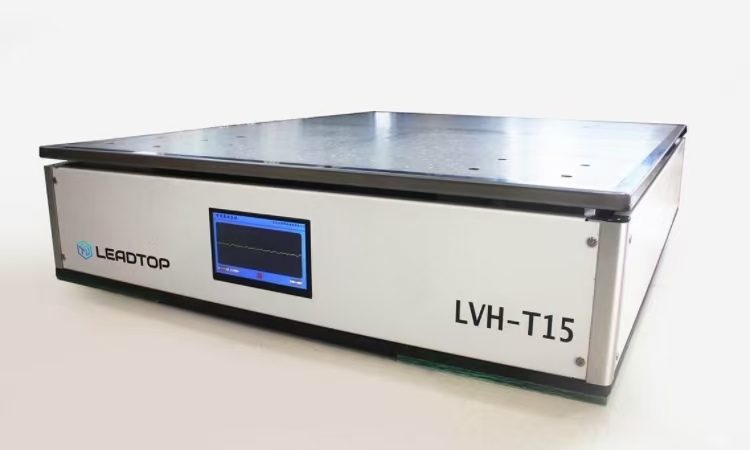
The LeadTop LVH-T15 heavy-load active vibration isolation platform was designed specifically to address this engineering challenge. Its core technical feature is a composite architecture combining electromagnetic actuators with a four-stage air spring system: the four-stage air springs bear the vertical heavy load (rated capacity 500 kg) and provide foundational low-frequency pneumatic isolation, while the electromagnetic actuators distributed across all degrees of freedom handle real-time dynamic compensation. In this composite operating mode, the LVH-T15 achieves vibration suppression across the full 0.5–200 Hz frequency band, with low-frequency attenuation exceeding 35 dB at 5 Hz (corresponding to approximately 98.4% of vibration energy eliminated) and the ability to complete suppression recovery for step disturbances on the order of 30 ms within an extremely short window.
An additional practical feature is online modal analysis—the system continuously monitors the vibration response spectrum across all degrees of freedom during operation, and upon detecting changes in external vibration source characteristics (such as the addition of a neighboring device with unknown operational properties), automatically adjusts compensation parameters to maintain optimal performance of vibration isolation for electron microscopes. As a supplier of vibration isolation optical platforms and accessories, LeadTop brings substantial technical expertise in this heavy-load active isolation domain, delivering a reliable engineering foundation for electron microscopy imaging, semiconductor inspection, and the life sciences.
The challenge of vibration isolation for electron microscopes lies not only in the frequency range and amplitude of vibrations, but also in their multi-directional nature. Vibrations in natural environments are never unidirectional—when a truck passes a building, it simultaneously excites vibration components in three translational directions (front-back X, left-right Y, up-down Z) and three rotational directions (pitch, yaw, roll). For electron microscopes, horizontal vibration components (especially in-plane translation perpendicular to the electron optical axis) often have a more severe impact on image resolution than vertical components, because lateral displacement of the electron beam on the sample surface directly translates into positional errors and resolution degradation in the image.
The core advantage of active vibration isolation for electron microscopes is precisely six-degree-of-freedom independent compensation: accelerometers and electromagnetic actuators are arranged separately on the platform's three translational axes and three rotational axes, with each detected vibration signal independently receiving a counter-force from the corresponding actuator, thereby achieving omni-directional, all-degree-of-freedom vibration cancellation.
The LVH-T15 heavy-load active isolation platform employs this six-degree-of-freedom active compensation technology, performing closed-loop control on vibration components in all six directions simultaneously within the 0.5–5 Hz building sway band, ensuring that the electron microscope maintains sub-nanometer sample chamber environmental stability even under heavy-load conditions. For cryo-EM, this six-degree-of-freedom full compensation means that during single-particle data acquisition lasting many hours, the electron beam remains precisely focused on the same thin region of the frozen specimen, enabling the resolution of the final three-dimensional reconstruction to approach the physical limit.
When evaluating vibration isolation systems for electron microscopes, the following core metrics serve as the key criteria for assessing performance level.
First is the isolation bandwidth—the effective frequency range within which the vibration transmissibility falls below a given threshold (typically -20 dB or better). Traditional air spring platforms typically have an isolation bandwidth starting from 2–3 Hz, whereas electron microscope vibration isolation systems employing a composite active approach (such as the LVH-T15) can extend the low-frequency effective bandwidth down to 0.5 Hz.
Second is the attenuation at specific frequency points—5 Hz is typically used as the benchmark frequency for low-frequency isolation performance, as it happens to represent the typical high-frequency boundary of building sway and traffic disturbances. An excellent vibration isolation system for electron microscopes should achieve over 30 dB of vibration attenuation at 5 Hz, corresponding to approximately 97% of vibration energy being isolated.
Third is the step-disturbance recovery time—the time required for the system to return to a set stable state after experiencing a sudden mechanical shock (e.g., accidental personnel contact, startup of adjacent equipment). For electron microscopy experiments, a recovery time exceeding one second means data acquisition is interrupted and refocusing may be required, so the recovery time of an electron microscope vibration isolation system should be on the order of hundreds of milliseconds or shorter.
Fourth is load capacity and center-of-gravity compatibility—electron microscopes commonly feature elevated and off-center centers of gravity, so the isolation platform must possess sufficient load capacity and anti-overturning stiffness to ensure long-term operational structural safety while maintaining active compensation precision.
Vibration isolation for electron microscopes has evolved from early passive rubber pads and air springs to today's electromagnetic-pneumatic hybrid active control full-bandwidth solutions, undergoing an engineering progression from passive resilience to active countermeasures. The driving force behind this evolution has remained constant—the pursuit of stability in electron microscopy imaging knows no endpoint. Whether for atomic-scale structural analysis in TEM, nanofabrication positioning in SEM, or single-particle three-dimensional reconstruction in cryo-EM, vibration isolation for electron microscopes constitutes the most fundamental yet indispensable line of defense in the entire system chain.
We hope this panoramic overview of vibration isolation technology for electron microscopes provides electron microscopy users across diverse fields with a substantiated, actionable technical reference when confronting isolation system selection decisions.


