A material revolution of vibration isolation pads for generators: the fatigue resistance advantage of composite rubber
Traditional rubber vibration isolation pads are prone to permanent deformation due to oxidation or fatigue. The LeadTop anti-creep solid rubber vibration isolation pad POT-X series, utilizing proprietary composite rubber technology, incorporates 15% polyester fiber and 3% graphite into natural rubber, forming a three-dimensional cross-linked structure.
The polyester fiber enhances tear resistance, while the graphite boosts thermal stability, ensuring the vibration isolation pad maintains its elasticity in an environment ranging from -40℃ to 80℃. Laboratory comparisons demonstrate that its fatigue resistance is three times that of ordinary rubber, enabling it to withstand the instantaneous impact force during generator start-up and shutdown.
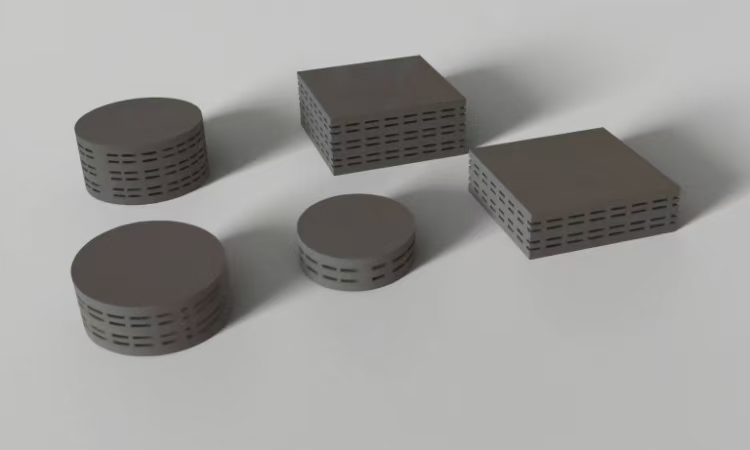
Structural innovation of vibration isolation pads for generators: dynamic balance between mesh and solid
The POT-X series breaks through the limitation of single structural design and introduces dual-form products: mesh and solid. The mesh pad reduces vertical stiffness through honeycomb-like hollow design, while the solid pad enhances horizontal damping through high-density rubber. In a case study of a wind farm, LeadTop engineers combined two layers of mesh pads with one layer of solid pad, reducing the vertical vibration acceleration of the generator from 0.8g to 0.2g and decreasing the horizontal swing amplitude by 65%.
At the same time, they adjusted the system's natural frequency to avoid the motor speed frequency band, completely eliminating the risk of resonance.
Long-term stability of vibration isolation pads for generators: creep control and life prediction
The vibration isolation pad for generators must meet the requirement of a service life of over 10 years. Through material modification and structural optimization, the POT-X series has managed to keep the extrapolated creep deformation within 35.6% over a 10-year period.
LeadTop has established a digital twin model that can predict the lifespan of the vibration isolation pad based on parameters such as load and temperature, enabling a replacement warning to be issued six months in advance.
summary
The technological evolution of vibration isolation pads for generators focuses on material compositing, structural modularization, and predictable service life. The LeadTop POT-X series, through its polyester fiber-graphite composite rubber, mesh-solid dual structure design, and digital twin technology, provides vibration isolation protection for generators throughout their entire lifecycle, redefining the standard for industrial vibration reduction.


