The core mechanism of vibration isolation principle
Vibration isolation achieves dynamic isolation between equipment and vibration sources by blocking or weakening the transmission path of vibration energy. The core vibration isolation principle is based on the formula of vibration transmission rate: when the external vibration frequency is higher than √ 2 times the natural frequency of the system, the transmission rate significantly decreases.
This mechanism is divided into passive isolation (relying on material elasticity and damping) and active isolation (canceling vibration through reverse force), which together form the cornerstone of modern isolation technology.
Passive vibration isolation principle: energy dissipation in materials science
Passive vibration isolation utilizes the elastic deformation of materials such as springs and rubber to absorb vibration energy. For example, metal coil springs disperse impact forces through coil deformation, while rubber isolators consume energy through molecular chain friction. This type of scheme has a simple structure, but its low-frequency isolation effect is limited.
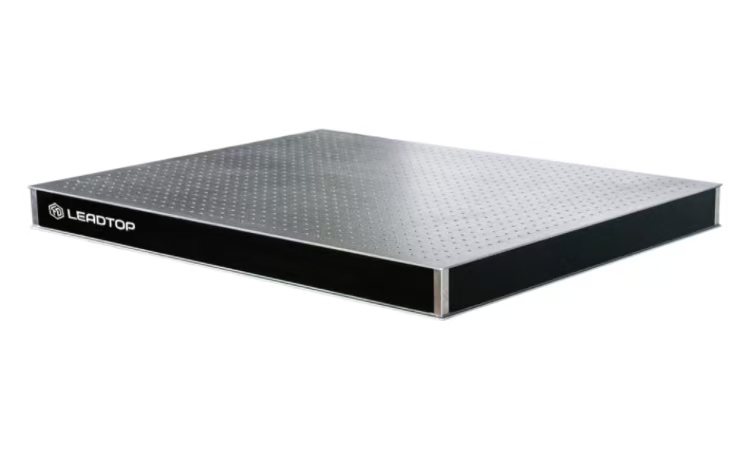
LeadTop's passive vibration isolation product, the honeycomb core optical platform MOT-F series, adopts a composite material and honeycomb structure design. By optimizing the stiffness and damping ratio, the natural frequency is reduced to below 2Hz, significantly improving low-frequency vibration isolation performance. It is suitable for industrial machine tools, construction equipment and other scenarios.
Active vibration isolation principle: precise confrontation of intelligent control
Active vibration isolation uses sensors to monitor vibration signals in real-time, driving electromagnetic actuators to generate reverse force and achieve "dynamic braking". Its core lies in a closed-loop control system that can dynamically adjust the magnitude and direction of the counteracting force.
For example, the quantum experimental platform needs to isolate broadband vibrations from 0.1Hz to 100Hz, and the active isolation system stabilizes the vibration amplitude at the nanometer level through multi axis sensors and adaptive algorithms.
LeadTop's active isolation platform LVH-T15 heavy-duty active isolation platform integrates high-precision sensors and fast response actuators, supports multi degree of freedom vibration control, and has become a "vibration firewall" for high-precision optical instruments and semiconductor equipment.

The future direction of vibration isolation technology
With the advancement of technology, vibration isolation is developing from a single function to intelligence and integration. In the future, vibration isolation systems will integrate IoT and AI algorithms to achieve remote monitoring and predictive maintenance. LeadTop has laid out the research and development of an intelligent isolation platform, which meets the needs of different scenarios through modular design.
For example, its optical isolation system can automatically identify vibration frequency bands and switch control modes, promoting the upgrade of isolation technology to full lifecycle management.


