While the isolation performance of a vibration isolation table is certainly critical, the tabletop as the foundational plane directly supporting optical components determines the system's overall precision through its material and structure. Tabletop flatness, rigidity, and surface treatment quality directly affect optical component positioning accuracy and experimental data reliability. Therefore, understanding the materials and structural design of vibration isolation table tabletops in depth is of great significance for proper selection.
Honeycomb structure tabletops use aluminum honeycomb cores, offering light weight and good rigidity, suitable for weight-sensitive scenarios. Welded structure tabletops employ mesh-welded skeletons with internal damping fill and medium-carbon steel reinforcement plates providing high mechanical strength with minimal load deformation. Taking LeadTop's welded optical platform tabletop MOT-H series as an example, its flatness reaches 0.05–0.1mm/m², with deformation less than 2µm/m², performing more stably in heavy-load and precision positioning scenarios.
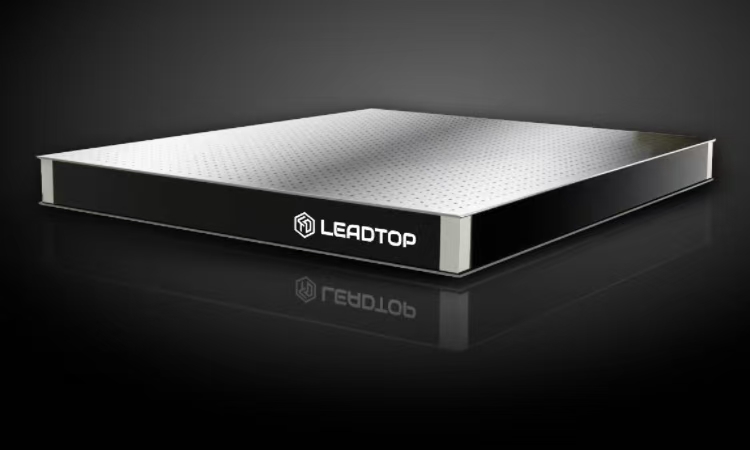
Surface treatment directly relates to optical component mounting accuracy and user experience. Matte finishing effectively reduces environmental light reflection, which is particularly important for optical experiments. Surface roughness controlled within 0.8–1.6μm ensures both optical base adhesion and easy cleaning maintenance. Superconducting magnetic stainless steel panels (1Cr13/1Cr17) not only resist rust and corrosion but also support direct magnetic base attachment, providing great convenience for rapid positioning and adjustment of optical components.
Resonance is one of the primary factors affecting vibration isolation table performance. Tabletop structural design plays a critical role in resonance suppression. Honeycomb structures disperse vibration energy through the geometric shape of the core material; welded structures absorb resonance through internal damping materials, complemented by isolation cups with stretch-formed aluminum stamping that provide dust and water resistance while optimizing damping characteristics. Both structures have their advantages, and users should choose based on the vibration spectrum characteristics of their experimental scenarios.
Selecting a vibration isolation table tabletop requires balancing flatness, rigidity, surface treatment, and resonance suppression across multiple dimensions. For general optical experiments, honeycomb tabletops offer lightweight and cost-effective solutions; for heavy-load or ultra-high precision scenarios, welded tabletops hold the advantage. LeadTop, as a professional supplier of vibration isolation optical platforms and accessories, provides both hollow cone isolation platforms and welded optical tabletops, helping users construct optimal vibration isolation systems based on actual needs. Choosing the right tabletop ensures the vibration isolation table's performance is truly realized.


