Passive vibration isolation type: "energy absorber" for basic protection
Passive isolation is the most widely used basic solution in vibration isolation types. It converts vibration energy into thermal energy or mechanical deformation dissipation through elastic elements such as springs, rubber, and air springs.
For example, LeadTop's POT-P series solid-state isolation optical platform adopts a multi-layer composite rubber isolation structure, with a vertical/horizontal natural frequency as low as 6.5-12Hz, which can effectively isolate mid to high frequency vibrations (50-200Hz). This type of vibration isolation has low cost and simple maintenance, but the low-frequency isolation efficiency is less than 30%, which is easily affected by resonance. It is suitable for scenarios with low vibration requirements such as microscopes and medical biological equipment.

Active vibration isolation type: "dynamic eliminator" for ultra precision scenes
The active vibration isolation type is a key technology to break through the low-frequency isolation limit. It monitors vibration signals in real-time through sensors, generates reverse compensation force through the controller, and outputs reverse vibration through actuators (such as piezoelectric ceramics and voice coil motors), achieving precise isolation of low and even ultra-low frequencies (below 0.1Hz).
LeadTop's TA400 desktop active isolation table adopts six degrees of freedom control technology, with an isolation efficiency of over 90% in the 1-200Hz frequency band and 95% at 5Hz, suitable for fields such as quantum technology and optical detection. This type of vibration isolation has a millisecond level response speed that can counteract 0.05nm level micro vibrations, but it has high system complexity and cost.

Active passive composite vibration isolation type: "hybrid scheme" covering the entire frequency band
The active passive composite vibration isolation type combines the advantages of passive and active, and is a representative solution for full frequency band coverage. The passive layer isolates high-frequency noise (>100Hz), while the active layer dynamically compensates for critical frequency bands (0.1-10Hz).
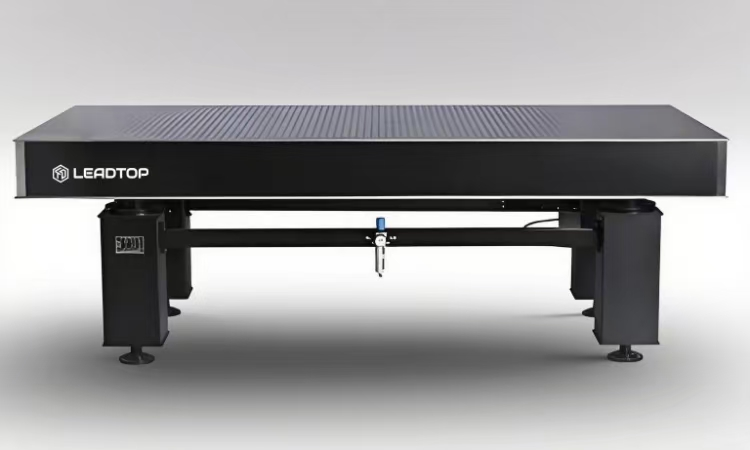
For example, LeadTop's ZDT-B series swing rod air floating isolator uses air springs for vertical low-frequency isolation (1.0-2.0Hz), optimizes the horizontal performance of the swing rod, and uses dampers to suppress high-frequency vibrations, achieving isolation efficiency of 86-94% in the 5-10Hz frequency band, suitable for semiconductor manufacturing, laser interferometry, and other scenarios.
Summary: Choose vibration isolation type as needed for precise protection
Passive vibration isolation type meets basic protection needs at low cost, active vibration isolation type breaks through the low-frequency limit, and active passive composite vibration isolation type achieves full frequency coverage. LeadTop provides precision protection solutions for laboratories and industrial sites, ranging from passive absorption to active cancellation, with a full range of products from POT-P to TA400, helping to ensure stable operation of precision equipment.


