It is a scenario every researcher dreads: the equipment is calibrated, the protocol is flawless, yet the data refuses to stabilize. After exhausting every troubleshooting avenue — recalibrating sensors, replacing components, rewriting analysis scripts — the issue persists. Frequently, the culprit is not the instrument but the environment. Micro-vibrations propagating through the building and ambient noise infiltrating the lab create a background of disturbance that can overwhelm even the most sophisticated measurement systems. Acoustic vibration isolation offers a systematic way to reclaim control.
Unlike simplistic approaches that treat vibration and noise as separate problems, acoustic vibration isolation integrates mechanical isolation, acoustic shielding, and active compensation into one cohesive environmental control strategy.
A thorough analysis of a typical laboratory reveals a surprising density of disturbance sources. Wind-induced sway of the building structure, elevator machinery cycling through its daily routine, air-handling units running continuously, occupants walking through corridors — each contributes a characteristic vibrational signature. Even distant subway trains can inject low-frequency energy that propagates for kilometers through the earth. Meanwhile, acoustic sources such as airflow turbulence in ductwork, fan noise from electronics racks, and conversations among lab personnel all contribute to an ambient sound field that can couple into sensitive apparatus.
The application of acoustic vibration isolation transforms this chaotic environment into a controlled space. By attenuating structural vibrations at the source and absorbing airborne acoustic energy before it reaches critical instruments, acoustic vibration isolation creates the stable baseline that precision work demands.
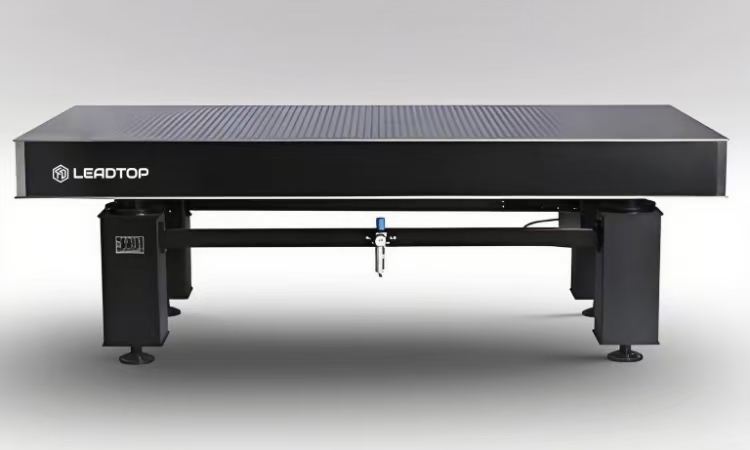
A deployed acoustic vibration isolation system functions as an environmental “firewall” for precision equipment. The vibration isolation stage employs pneumatic or pendulum-based supports with tuned stiffness to achieve ultra-low natural frequencies, effectively decoupling the payload from ground motion. The acoustic enclosure adds mass-law sound attenuation combined with porous absorption to handle the airborne noise pathway.
Advanced implementations incorporate active vibration cancellation: accelerometers continuously monitor residual motion, digital signal processors compute the required counter-forces, and electromagnetic actuators apply them in real time. This closed-loop approach extends the effective bandwidth of acoustic vibration isolation well into the low-frequency regime where passive methods alone fall short. Products like the LeadTop ZDT-B series embody this multi-layered philosophy, offering 99% isolation efficiency, pneumatic auto-leveling, and a silent compressor that operates below 50 dB.
Successfully implementing acoustic vibration isolation requires more than purchasing the right hardware. Site selection plays a crucial role: basement and ground-floor locations naturally benefit from the massive damping provided by direct foundation contact. During system commissioning, precise leveling and alignment are essential to realizing the specified performance. Post-installation, a regimen of periodic inspections — checking air supply pressure, verifying sensor calibration, assessing enclosure seals — ensures that the acoustic vibration isolation system maintains its protective capabilities over years of service.
Organizations that treat acoustic vibration isolation as an ongoing commitment rather than a one-time purchase consistently report better experimental outcomes, fewer unexplained data artifacts, and longer instrument lifetimes.
In the relentless pursuit of accuracy, every variable matters. The environment in which an instrument operates is not a background detail — it is a first-order determinant of performance. Acoustic vibration isolation provides the foundation upon which precise, repeatable, and trustworthy measurements are built. For any laboratory or manufacturing facility that values data integrity, investing in a proper acoustic vibration isolation solution is one of the most consequential decisions it can make.


