Load capacity is the first parameter that must be confirmed when selecting an active vibration isolation platform. Different models vary significantly in their load ranges. Light-duty platforms are suitable for precision instruments under 100kg, while heavy-duty models can support large equipment weighing several hundred kilograms. If the load capacity is selected too low, the platform will experience degraded isolation performance under overload conditions and may even damage the actuators. Selecting too high means unnecessary cost expenditure. In practice, it is recommended to reserve a 20% to 30% safety margin above the total equipment weight. The LVH-T15 heavy-duty active vibration isolation platform from LeadTop provides 500kg ultra-large load capacity, meeting the needs of most heavy-duty precision instruments, making it a reliable choice for heavy-load scenarios such as electron microscopy imaging and semiconductor inspection.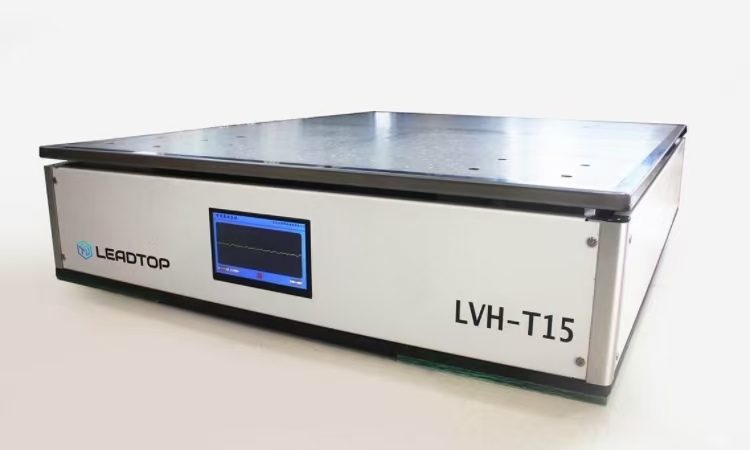
Isolation frequency range and low-frequency attenuation capability are the core indicators for evaluating active vibration isolation platform performance. Passive isolation solutions perform adequately above 10Hz but are virtually powerless below 5Hz, which is precisely where major interference sources such as building resonance and traffic vibrations concentrate. Active vibration isolation platforms achieve far superior attenuation in the ultra-low frequency range through closed-loop active control. During selection, pay particular attention to the attenuation specification at 5Hz. Attenuation exceeding 35dB corresponds to approximately 90% isolation efficiency, serving as a key reference value for determining whether a platform meets low-frequency performance standards. The TA800 series active vibration isolation platform from LeadTop achieves six-degree-of-freedom vibration suppression across the 1 to 200Hz frequency range, comprehensively covering vibration interference from ultra-low to mid-high frequencies.
Step disturbance suppression time reflects the active vibration isolation platform response capability to sudden interruptions. In practice, foot traffic, door operations, and equipment startups all generate step-type transient vibrations. If the platform response speed is insufficient, these transient disturbances will continue affecting precision equipment operation during the recovery process. Industry-leading active vibration isolation platforms typically achieve step disturbance suppression times between 30 and 100ms, with faster speeds meaning less impact from transient disturbances on the equipment. The LVH-T15 active vibration isolation platform from LeadTop achieves step disturbance suppression in just 30ms, representing an industry-leading level that ensures precision equipment rapidly returns to a stable state after sudden vibration events.
Beyond core isolation performance, installation space and intelligent features are factors that should be considered during selection. Laboratory space is limited, and platform thickness directly affects installation feasibility. Ultra-thin designs of 100 to 115mm can be installed on standard laboratory benches without additional foundation modifications. Regarding intelligent features, online modal analysis enables real-time monitoring of platform vibration status, automatic load compensation adapts to weight changes from different experimental configurations, and remote monitoring facilitates status management in unattended scenarios. The TA series active vibration isolation platform from LeadTop features a body thickness of only 100 to 115mm with a compact aviation aluminum design that fits laboratory space constraints, while its fully automatic height adjustment system compensates for load changes within a plus or minus 5mm range in real time, representing an optimal solution that balances performance with installation convenience.


