Traditional vibration isolation solutions typically employ fixed-parameter passive damping systems that cannot be adjusted once designed and installed. While this may suffice under ideal conditions with constant equipment weight and stable vibration environments, performance bottlenecks emerge when equipment changes, loads vary, or environmental vibration characteristics shift. Adjustable dampers fundamentally solve this problem by allowing users to flexibly adjust isolation parameters based on actual load and vibration conditions.
The POT-G series hollow conical vibration isolation platform supports manual leveling with precise height adjustment within a plus or minus 10mm range. This flexibility enables a single adjustable damper to accommodate precision equipment of different weights and sizes, significantly enhancing equipment versatility and utilization efficiency.
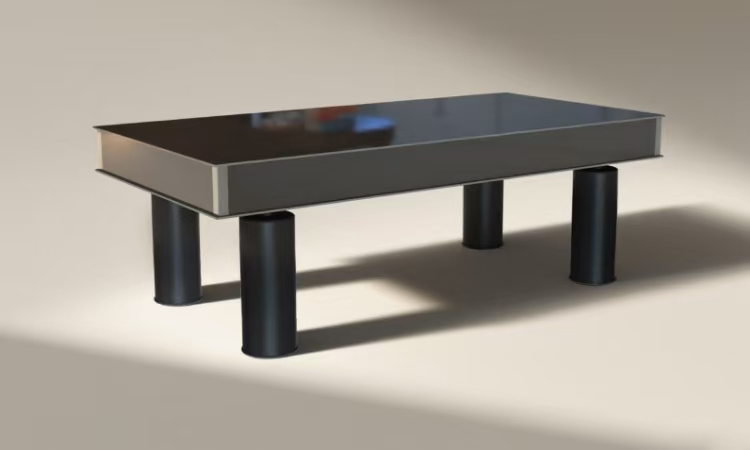
Traditional rubber or spring isolation devices perform adequately above 10Hz but experience significant performance degradation in the 4 to 8Hz low-frequency range, where the primary vibration disturbances in laboratory buildings-floor resonance, traffic vibrations-are concentrated. Adjustable dampers achieve superior isolation performance in the low-frequency range through optimized structural design and wider parameter adjustment ranges.
LeadTop adjustable damper products achieve low natural frequency ranges of 4.0 to 8.0Hz in both vertical and horizontal directions, paired with honeycomb or superconducting magnetic isolation tabletops to further suppress surface resonance, delivering outstanding performance in demanding low-frequency isolation applications such as microscopy imaging and laser scanning.
Traditional isolation solutions often require precise load calculation and customized damping parameters during installation, making the process complex and time-consuming. Adjustable dampers simplify this process by allowing post-installation fine-tuning through adjustment mechanisms without repeated disassembly.
In terms of maintenance, the POT-G series adjustable damper features a structurally robust frame design that minimizes routine maintenance needs. For research laboratories that frequently change equipment or experimental configurations, adjustable dampers offer significant advantages in installation convenience and routine maintenance.
If your laboratory handles diverse equipment types, experiences frequent load changes, or faces uncertain vibration environments, adjustable dampers are the most rational choice. Conversely, if equipment is fixed, the vibration environment is stable, and vibration frequencies fall within the effective range of passive isolation, traditional fixed-parameter solutions may also suffice. When making a selection, focus on natural frequency range (the lower, the better), leveling range and precision, table flatness, and material durability.
LeadTop, as a supplier of vibration isolation optical platforms and accessories, has earned widespread recognition in the adjustable damper market for its POT-G series, featuring hollow conical rubber isolation structure, performance approaching air isolation platforms, and reliable construction quality.


