The root cause of vibration interference: the dual challenges posed by mechanical vibration and external disturbances
Precision instruments are highly sensitive to vibration, and even micrometer-level vibration can lead to measurement errors or equipment malfunctions. Mechanical vibration primarily originates from the operation of the equipment itself (such as the periodic impact of motors and pumps), while external disturbances include environmental vibrations from ground traffic, personnel movement, etc.
For example, the probe of an atomic force microscope can deviate from its target position by more than 50nm under 10Hz vibration, directly resulting in blurred imaging. To address the vibration issue, it is necessary to approach from two dimensions: "isolating the vibration source" and "absorbing vibration energy", achieving dynamic balance through passive vibration isolation and active control techniques.
How passive vibration isolation technology reduces vibration: the art of energy conversion between materials and structures
Passive vibration isolation converts vibration energy into thermal energy or elastic potential energy through the combination of elastic elements (such as springs, rubber) and damping elements (such as viscous fluids, metal wire mesh). For example, multilayer composite rubber vibration isolators utilize rubber shear deformation to absorb medium-to-high frequency vibrations (50-500Hz), which are low-cost and maintenance-free, and are widely used in scenarios such as microscopes and medical equipment.
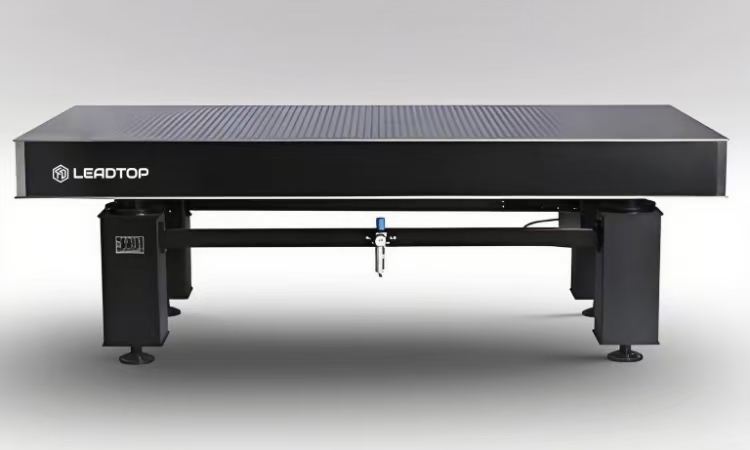
The air spring vibration isolation platform achieves variable stiffness by adjusting air pressure. The ZDT-B series air-bearing pendulum platform from LeadTop reduces the horizontal natural frequency to 1.2Hz, achieving a vibration isolation efficiency of 86% in the 5-10Hz frequency band, making it a core supporting component for high-precision equipment such as laser interferometers. Its honeycomb table plate structure (with a flatness error of ≤0.05mm/㎡) effectively disperses loads, avoiding performance degradation caused by local stress concentration.
How active vibration isolation technology reduces vibration: millisecond-level response of intelligent algorithms and actuators
Active vibration isolation monitors vibration signals in real-time through sensors, and drives actuators such as piezoelectric ceramics and voice coil motors to generate counteracting forces, achieving efficient suppression of low-frequency vibrations (1-200Hz).
The LeadTop TA800 active vibration isolation platform is equipped with an adaptive control algorithm that can dynamically adjust parameters according to changes in the vibration source, achieving dynamic leveling within 10-20ms, ensuring the stability of equipment such as femtosecond laser systems. By deploying this platform, a quantum laboratory reduced the vibration interference in cold atomic experiments to within ±0.1μm, and increased the success rate of data acquisition by 40%.
In addition, the combined use of active and passive vibration isolation can expand the frequency band coverage. For example, the "active damping + air spring" solution achieves vibration isolation efficiency exceeding 90% across a wide frequency band of 0.5-200Hz, making it suitable for ultra-precision scenarios such as wafer inspection and lithography machines.

Scenario-based selection strategy: comprehensive consideration of load, frequency, and environment
Choosing a vibration isolation platform requires consideration of both the characteristics of the equipment and the usage scenario:
Load capacity: Optical instruments require lightweight platforms (load <100kg), while heavy-duty processing equipment needs to support products weighing over 300kg;
Natural frequency: The vibration isolation efficiency is inversely proportional to the natural frequency of the platform. For low-frequency equipment (such as electron microscopes), a platform with a natural frequency of <2Hz should be selected;
Leveling function: The ZDT-P series from LeadTop supports ±10mm pneumatic leveling, allowing for installation and calibration to be completed in just 10 minutes, adapting to environmental changes such as ground subsidence;


