Active vs. Passive Isolators: Technical Essence and Application Boundaries
The core objective of isolators is to protect equipment by blocking or attenuating the vibration transmission chain. Their technical approaches fall into two main categories: active control and passive energy dissipation. Active isolation relies on real-time vibration monitoring and counterforce compensation, suitable for low-frequency (<10Hz) high-intensity vibration scenarios, though it involves higher system complexity.
Passive isolation achieves energy conversion through elastic element deformation and internal damping material dissipation, offering zero maintenance and high reliability—making it the preferred solution for precision optics, semiconductor manufacturing, and similar fields. Leveraging two decades of passive vibration isolation expertise, LeadTop has developed a comprehensive product portfolio covering the entire frequency spectrum.
LeadTop Passive Vibration Isolator Series: Technical Specifications and Application Scenarios
Features ultra-thin airbags and a high-precision pneumatic servo system for millimeter-level automatic leveling, with adjustable damping frequency via external dampers. With a vertical natural frequency of 1.8-2.5Hz and 5Hz isolation efficiency reaching 82-88%, it suits conventional precision equipment like microscopes and biological sample analyzers, balancing cost and performance.
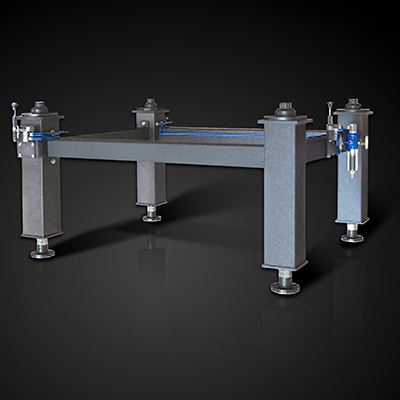
Redesigned horizontal dynamics based on single-pendulum principles, lowering horizontal natural frequency to 1.0–1.3 Hz and vertical frequency to 1.0–1.8 Hz. Combined with composite air chambers and three-stage damping adjustment, it achieves over 90%/92% isolation efficiency at 5 Hz vertically/horizontally. Engineered for ultra-low-frequency vibration-sensitive applications like laser interferometry and quantum optics experiments.
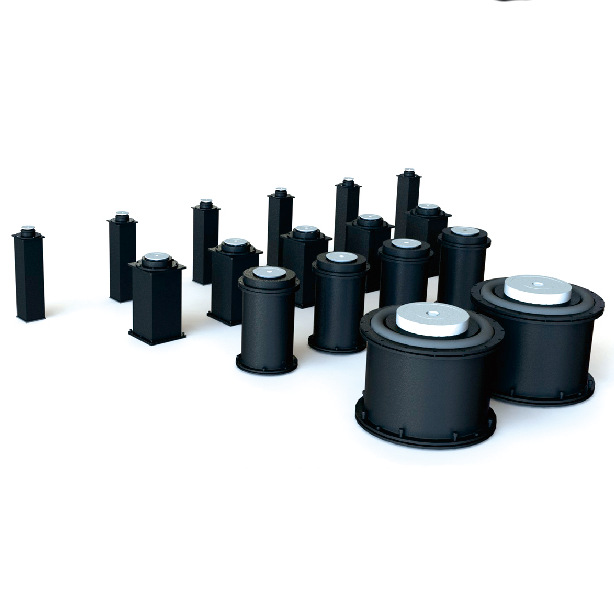
Featuring hollow conical rubber structures and molecular-level damping formulations, it achieves efficient attenuation of mid-to-high frequency vibrations (4-10Hz) with a load capacity of 50-800kg. Its nonlinear damping characteristics reduce resonance peaks by over 60%, making it suitable for industrial vibration isolation needs like optical coating machines and SMT placement equipment.

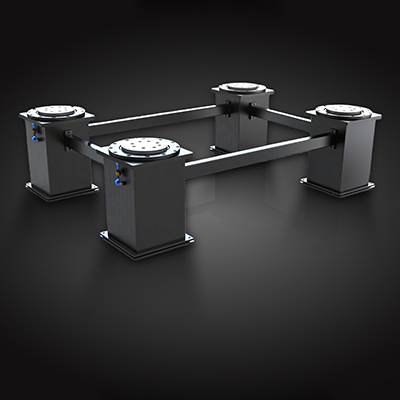
Innovatively employing porous quasi-laminar damping technology, it maintains low-frequency performance (1.2-2.5Hz) while elevating load capacity to the 2-ton class. Achieving 80-85% isolation efficiency at 5Hz with a recovery time <1.5s, it perfectly matches high-dynamic load scenarios like coordinate measuring machines and heavy-duty laser machining centers.
The entire LeadTop vibration isolator series is ISO9001 certified. Beyond forging product reliability through stringent standards, it delivers full-cycle technical services—from vibration testing and solution design to implementation—establishing a “zero-vibration” technological barrier for precision manufacturing and scientific exploration. This empowers users to uncover truths at the microscopic level and seize competitive advantages in macro-scale industries.


