
Vibration Isolators: The “Vibration Busters” for High-Precision Applications
Vibration is the “invisible killer” of precision equipment, causing blurred imaging, measurement errors, and even hardware damage. Vibration isolators absorb and dissipate vibrational energy through elastic damping structures, serving as core protective components in optical instruments, semiconductor manufacturing, biomedicine, and other fields. Their value extends beyond mere “shock absorption”—they ensure stable equipment performance by precisely matching application requirements.
Vibration Isolators for Mid-to-High Frequency Isolation: Rubber Isolators as the Cost-Effective Choice
In vibration-sensitive applications like microscopy and optical inspection, mid-to-high frequency vibrations (10-1000Hz) are primary sources of interference. LeadTop's POT-G Series hollow conical rubber isolators utilize advanced rubber compounds and conical designs to increase damping coefficients and shorten recovery cycles, controlling natural frequencies between 4-8Hz for effective isolation of mid-to-high frequency vibrations.

For applications demanding higher horizontal isolation, the POT-P series solid rubber isolators optimize horizontal stiffness through composite rubber structures. They achieve vertical/horizontal natural frequencies of 6.5-12Hz and 3-8Hz respectively, with damping ratios of 0.05-0.2 balancing stability and response speed. Paired with height-adjustable bases for micron-level leveling, they serve fields like medical and biological research with low vibration tolerance.
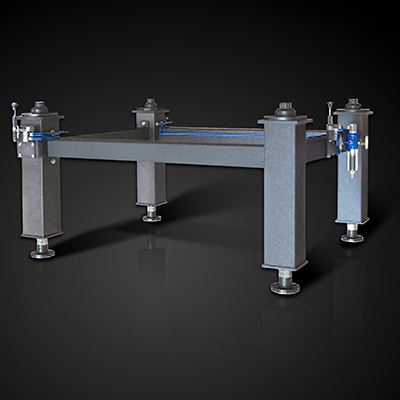
Isolators for Ultra-Low Frequency Vibration Control: The “Technical Peak” of Air-Floating Isolators
For equipment like laser interferometers and coordinate measuring machines, ultra-low frequency components (1-10Hz) in environmental vibrations directly compromise measurement accuracy. LeadTop's high-damping air-bearing ZDT-Z series utilizes ultra-thin composite airbags and multi-pore quasi-laminar flow damping technology to reduce vertical natural frequencies to 1.0-2.5Hz. It achieves 80-86% isolation efficiency at 5Hz, with external damping regulators enabling dynamic resonance suppression.
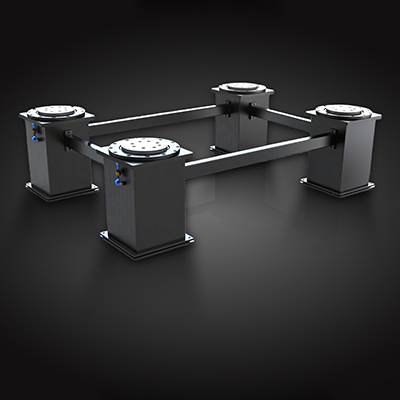
For enhanced horizontal performance, the pendulum-type ZDT-B series employs a single-pendulum design with a low horizontal natural frequency of 1.0–1.5Hz. It achieves 5Hz isolation efficiencies of 86–92% vertically and 88–94% horizontally, establishing itself as the ultimate protection solution for nanometer-level measurement equipment.
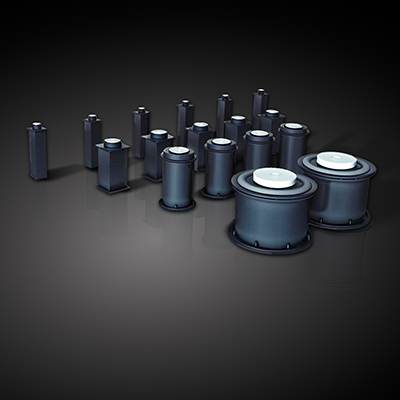
Isolator Selection Methodology: Deriving Technical Parameters from Application Pain Points
Isolator selection follows a three-step approach:
From the cost-effective rubber isolators to the ultra-precise air-bearing isolators, isolator applications have evolved into a “precision strike campaign” targeting vibration spectra. LeadTop redefines isolation standards through innovative materials and structural design, delivering comprehensive solutions for high-precision manufacturing—transitioning from “passive defense” to “active optimization.”


