Introduction: The Importance of isolation table
In the fields of precision research and high-end manufacturing, the correct selection of isolation tables is directly related to the accuracy of experimental results and the service life of equipment. Many users often only focus on price when purchasing, neglecting the compatibility of technical parameters, resulting in various problems in later use. This article will provide users with a selection guide for system isolation tables from dimensions such as load requirements, frequency characteristics, and environmental conditions.
1、 Clarifying load requirements is the first step in selection
Equipment weight and load-bearing capacity
When selecting an isolation table, the first step is to calculate the total weight of the supported equipment, including the host, accessories, operating tools, etc. Suggest reserving a safety margin of 20% -30%. Light load isolation table (≤ 150kg) is suitable for small optical instruments, medium load type (≤ 300kg) is suitable for SEM and other equipment, and heavy-duty type can support overweight platforms of more than 10T.
Center of gravity distribution and stability
The center of gravity position of the equipment affects the stability of the isolation table. High center of gravity equipment requires a larger support area and lower natural frequency. LeadTop provides customized services that optimize the layout of support points based on the distribution of device center of gravity, ensuring long-term stable operation.
Dynamic load consideration
Some devices may experience dynamic load changes during operation, such as robotic arm movement, sample replacement, etc. The isolation table needs to have sufficient dynamic response capability to avoid leveling failure caused by sudden load changes.
2、 Frequency characteristics determine the isolation effect
Vibration source frequency analysis
The vibration frequency characteristics vary greatly in different environments. The factory environment is mainly characterized by low-frequency vibration (5-20Hz), office buildings are mainly characterized by medium frequency (20-50Hz), and the vicinity of transportation arteries contains broadband components. Before selection, on-site vibration testing should be conducted to determine the main interference frequencies.
The natural frequency of the isolation table should be much lower than the interference frequency (generally requiring less than 1/3) in order to effectively isolate vibrations. For example, for ground vibrations of 10Hz, an isolation table with a natural frequency below 3Hz should be selected.
Active and passive scheme selection
Passive isolation table is suitable for isolating mid to high frequency vibrations (>5Hz), with low cost and simple maintenance. The active isolation stage can achieve ultra-low frequency isolation below 1Hz, suitable for extreme precision applications such as atomic force microscopy and quantum computing, but it is expensive and requires power support.
The TA800 desktop active isolation table achieves six degrees of freedom vibration suppression in the 1-200Hz wide frequency band, with isolation efficiency>90% @ 5Hz and response speed of 10-20ms, suitable for ultra precision equipment that is extremely sensitive to vibration.

Six degree of freedom omnidirectional vibration isolation
The high-end isolation platform should achieve omnidirectional isolation with six degrees of freedom (three translations+three rotations). Isolation in a single direction may cause amplification of vibrations in other directions, affecting the overall effect.
3、 Environmental conditions affect product selection
Special requirements for clean rooms
Clean room environments such as semiconductor and biological laboratories have special requirements for isolation tables. A completely sealed hole structure must be adopted to avoid the accumulation of particles; The surface should be rust proof and easy to clean, and 430 stainless steel panels are an ideal choice.
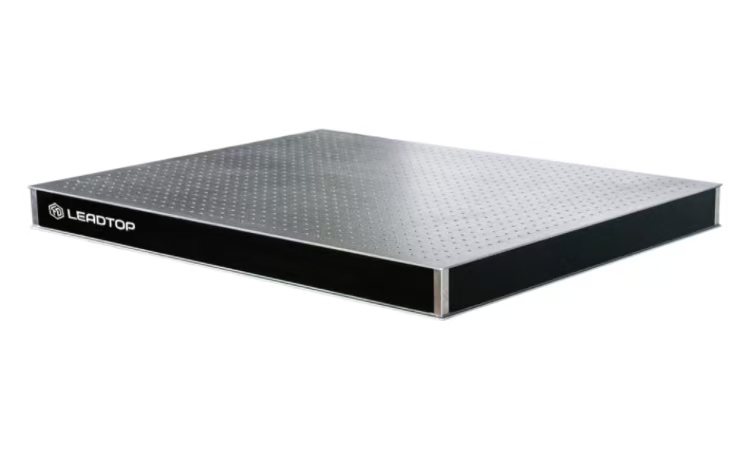
The MOT-F series honeycomb core optical platform adopts a completely sealed hole structure, without welding stress. The panel is made of 430 stainless steel, which is rust proof and easy to clean, making it very suitable for use in clean rooms.
Temperature and humidity control
Temperature changes can cause material expansion and contraction, affecting the flatness of the isolation table. High quality products should use materials with low thermal expansion coefficient and consider temperature compensation during design. High humidity environments require anti-corrosion treatment.
Space limitations and installation conditions
When the laboratory space is limited, a table type vibration isolation table can be chosen, which has a compact structure and easy installation. For large equipment, installation conditions such as floor load-bearing capacity, door opening size, and elevator capacity need to be considered.
4、 Balance budget and cost-effectiveness
Initial investment and long-term costs
The procurement cost of the isolation table not only includes the equipment itself, but also the full life cycle costs such as installation, commissioning, and maintenance should be considered. The air flotation type requires continuous consumption of compressed air, the active type requires power support, and the passive rubber type has the lowest maintenance cost.
Brand and after-sales service
Choosing a well-known brand of vibration isolation table may require a higher initial investment, but it can provide better technical support and after-sales service. LeadTop, as a supplier of vibration isolation optical platforms and accessory products, has agents in multiple locations across the country and can provide fast response technical services.
Scalability and upgrade space
Considering future equipment upgrade requirements, the isolation platform should have a certain degree of expansion capability. Modular design products can flexibly adjust their size and load-bearing capacity, avoiding duplicate investments.
5、 Common selection misconceptions and pitfalls avoidance guide
Misconception 1: Only focusing on price without considering parameters
The low-priced vibration isolation table may shrink in key parameters, such as inadequate flatness, high natural frequency, and insufficient leveling accuracy, ultimately affecting the experimental results.
Misconception 2: Neglecting installation foundation
The isolation platform requires a flat and sturdy installation foundation. Uneven ground can make leveling difficult, and insufficient floor stiffness can amplify vibrations. Before installation, a basic inspection should be conducted, and reinforcement treatment should be carried out if necessary.
Misconception 3: Excessive pursuit of high-end configurations
Not all applications require an active isolation table. For general optical experiments, air flotation can already meet the requirements. Selection should be based on actual needs to avoid wastage of resources.
Conclusion: Scientific selection ensures successful experiments
The selection of isolation table is a systematic project that requires comprehensive consideration of technical parameters, environmental conditions, budget constraints, and other factors. It is recommended that users conduct thorough research before purchasing and consult professional engineers if necessary to choose the most suitable isolation table product for their own needs, providing reliable vibration isolation guarantee for precision experiments.


