With the rapid advancement of precision optical technology, performance requirements for optic tables are continuously increasing. From basic experiments to advanced semiconductor inspection, technical standards are becoming increasingly stringent. This article provides an in-depth interpretation of the key technical parameters of optic tables and analyzes application trends across different industries.
Natural frequency is the primary indicator of vibration isolation performance—the lower, the better the low-frequency isolation. Mainstream optic tables typically have vertical and horizontal natural frequencies of 4.0–8.0Hz. Low-frequency isolation is a core design challenge for any optic table, as low frequencies are harder to attenuate through passive methods. Breadboard flatness is another key parameter, with high-precision optic tables requiring 0.05–0.1mm/m². Surface roughness after matte finishing should be controlled at 0.8–1.6μm, effectively suppressing stray light. Standard optic table height is 800mm with ±10mm manual leveling capability.
Common isolators fall into two categories: pneumatic types using compressed air elasticity, offering excellent performance but requiring an air source; and elastomeric types that are simple and maintenance-free. The LeadTop POT-G series hollow-cone vibration isolation optic table combines hollow-cone rubber isolators with MOT series breadboards at 800mm height, 4.0–8.0Hz frequency, and 0.05–0.1mm/m² flatness. As a leading supplier of vibration isolation optic tables and accessories, LeadTop provides flexible configuration solutions meeting diverse needs across research and industrial settings.
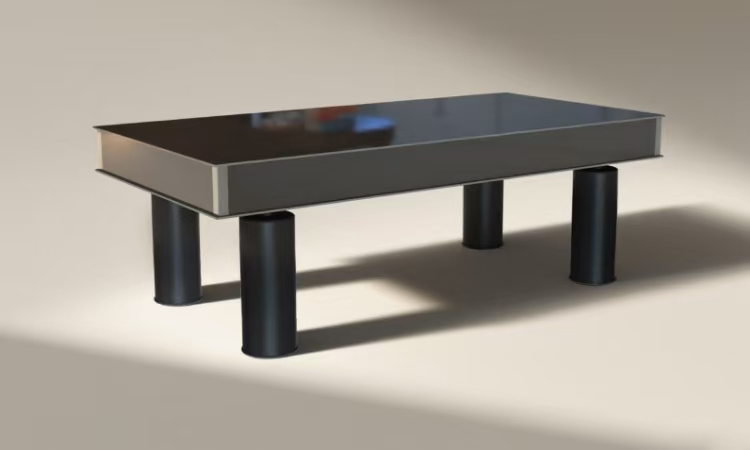
Semiconductor manufacturing is extremely sensitive to vibration—nanometer-scale disturbances can cause irreversible chip defects. optic tables play a foundational isolation role in lithography machines and wafer inspection equipment, directly safeguarding chip yields. In life sciences, confocal, two-photon, and super-resolution microscopes all rely on an optic table for stable imaging. Whether in semiconductor fabs or biomedical labs, a precision optic table is the quiet enabler of accuracy at the cutting edge.
The next generation of optic tables will evolve toward higher precision and intelligence. Active vibration isolation technology using sensors and actuators for real-time vibration compensation already outperforms traditional passive optic tables in demanding applications. IoT-integrated monitoring systems enable real-time performance tracking and early warning of degradation. From passive to active control, optic tables are progressing toward higher performance and smarter operation, unlocking new possibilities for ultra-precision experiments.
As fundamental equipment for precision experiments and advanced manufacturing, the technological progress of optic tables continues to drive related fields forward. Selecting an optic table with compliant parameters and reliable performance is a crucial step in ensuring the smooth progress of precision work.


