When choosing an optical platform, there are a bunch of terms on the technical parameter table: natural frequency, damping ratio, stiffness, transmission rate... making you dizzy? In fact, mastering only three core indicators is enough to quickly assess platform performance. This is the "golden triangle" for optical platform selection. Master these three indicators and make the right choice in 3 minutes.
Indicator 1: Natural frequency - determines the lower limit of vibration isolation
What is natural frequency? Every elastic system has a natural preferred vibration frequency. When the external vibration frequency approaches the natural frequency, resonance occurs and the vibration is amplified instead. So, the lower the natural frequency, the less likely the system is to resonate, and the wider the vibration frequency range that can be isolated. This is a physical law, there are no shortcuts.
Indicator 2: Damping ratio - determines energy dissipation efficiency
What is damping ratio? Damping ratio describes the ability of a system to dissipate vibrational energy. The larger the damping ratio, the faster the vibration attenuation. The damping ratio is too low, the resonance peak is sharp, and specific frequency vibrations are amplified; The damping ratio is too high, resulting in slow system response and affecting dynamic performance. The ideal range is 0.05~0.15, which is 5%~15%.
Indicator 3: Stiffness - determines load-bearing capacity and stability
What is stiffness? Stiffness describes the ability of a system to resist deformation. The higher the stiffness, the smaller the deformation under load. The stiffness is too low, causing deformation of the platform under load and affecting the flatness of the tabletop; Excessive stiffness leads to an increase in natural frequency and a decrease in vibration isolation performance. The equilibrium point is the higher the stiffness, the better, while ensuring the natural frequency.
LeadTop products are made of stainless steel material, which has high mechanical strength. The rigid optical platform GZT series adopts a broadband damping structure platform design, which effectively suppresses surface resonance. It can be selected from honeycomb structure or superconducting magnetic isolation platform, with high strength and stable reliability. The platform has a height of 800mm and supports manual leveling (± 10mm adjustment range). The flatness of the platform can reach 0.05-0.1mm/㎡, and the surface is matte treated with a roughness of only 0.8-1.6 μ m. It can be moved with wheels. Suitable for optical target experiments, long-distance aiming, and instruments and equipment with low vibration requirements, with stable structure and minimal maintenance, it is an ideal choice for precision optical experiments.
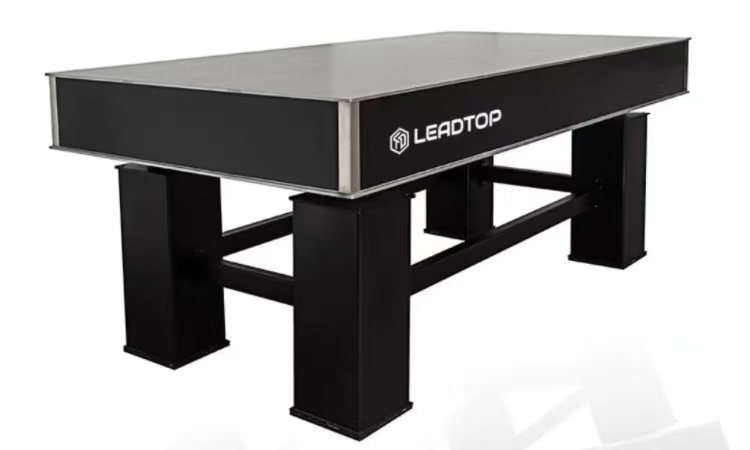
The MOT-Z series heavy-duty platform adopts a mesh welding structure, with built-in damping materials to suppress resonance. The medium carbon steel plate provides high mechanical strength and stability, and the platform has a heavy weight, lowered center of gravity, and small load deformation. The panel is made of stainless steel (1Cr13/304) with a thickness of 10-20mm. The holes are arranged in metric M6 and 25/50mm spacing arrays, with a flatness of 0.05-0.1mm/m ² and a roughness of ≤ 1.6 μ m. The surface is treated with a matte finish. Suitable for overweight scenarios with high stability requirements such as experimental bases and precision testing, providing a sturdy and reliable installation platform.

The relationship of the Golden Triangle
These three indicators are interrelated: the natural frequency decreases, the isolation frequency band increases; Moderate damping ratio, optimal energy dissipation; Stiffness balance, balancing load-bearing and vibration isolation. Ideal optical platform: natural frequency low enough, less than or equal to 2Hz; damping ratio within the ideal range, 0.05~0.15; The stiffness meets the load-bearing requirements.
Quick selection checklist: Natural frequency less than or equal to 2Hz, required for micrometer level accuracy; The damping structure is broadband damping, which suppresses resonance; Leveling accuracy is less than or equal to plus or minus 0.1mm; tabletop flatness is less than or equal to 0.1mm per meter; The carrying capacity meets the weight of the equipment plus a 20% margin. LeadTop's product line fully covers these requirements, with a professional team providing selection support.
Conclusion: Master the "Golden Triangle" and make the right choice in 3 minutes. The natural frequency determines the lower limit of vibration isolation, the damping ratio determines the energy dissipation efficiency, and the stiffness determines the bearing stability. Balancing the three is a good platform. LeadTop ZDT-B series, with a natural frequency of 1.0~2.0Hz, a damping structure with broadband damping, and a leveling accuracy of plus or minus 0.1mm, is an ideal choice for precision optical experiments.


