
The Physical Foundation of Vibration Isolation Technology Principles
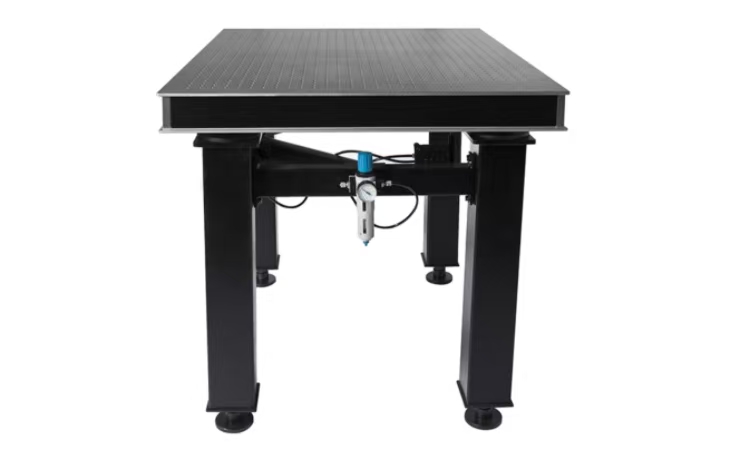
The core of vibration isolation technology lies in using elastic elements to alter the vibration transmission path. When the vibration source frequency is higher than the square root of 2 times the system's natural frequency, the vibration transmission rate significantly decreases. For instance, LeadTop's ZDT-P series air-float vibration isolation optical platforms precisely control the vertical/horizontal natural frequency within 1.0 to 2.0 Hz through air springs and ultra-thin composite airbags.
Its multi-small-hole quasi-laminar damping technology achieves a vibration isolation efficiency of 78 to 95% in the 5-10 Hz frequency band, providing an ultra-quiet environment for laser interferometers and precision measurement equipment. The design of the platform's surface flatness at 0.05 to 0.1 mm/㎡ further ensures the stability of optical systems.
Intelligent Breakthroughs in Active Vibration Isolation Technology
Passive vibration isolation has resonance defects in the low-frequency range, while active vibration isolation achieves dynamic compensation through closed-loop control of sensors and actuators. LeadTop's LHV series active vibration isolation modules adopt an air spring + pendulum decoupling design, combined with a six-degree-of-freedom precise control algorithm, to achieve vibration attenuation of ≤-30dB in the 0.5-20Hz low-frequency range.
Its 8ms rapid response capability can withstand 25g impacts, support ±2μm displacement compensation and 0.5-5ton intelligent load adaptation. It has been successfully applied to the nanometer-level stable support of quantum research equipment, solving the problem that traditional vibration isolation systems are difficult to balance low-frequency and high-precision requirements.

The principle and application of vibration isolation technology across industries and its precise adaptation
In the medical field, vibration isolation technology has increased the imaging resolution of MRI equipment by 40%; in acoustic laboratories, the air floatation support system has controlled the background noise to below NC-15. LeadTop's air floatation platform supports ±10mm height adjustment and pneumatic automatic leveling, and when combined with a silent air compressor (<50dB), it becomes an ideal choice for scenarios such as biological microscopic imaging and semiconductor manufacturing.
From basic theory to engineering practice, vibration isolation technology, through the integration of active and passive methods and scenario-based design, has established a vibration protection system covering from micro-experiments to macro-equipment. The innovative practices of brands like LeadTop indicate that intelligent vibration isolation systems are becoming the core infrastructure of high-precision industries, continuously driving the upgrading of industrial stability standards.


