
Vibration interference: the "invisible killer" of precision equipment
Precision instruments are highly susceptible to external vibrations during operation, such as ground traffic and equipment resonance, which can lead to measurement errors, blurred imaging, and even equipment damage. The core task of a vibration isolation system is to isolate or attenuate vibration energy through physical means, providing a stable operating environment for optical, electronic, and other equipment, and ensuring the reliability of experiments and production.
Dual-mode working principle of vibration isolation system
Vibration isolation systems are primarily categorized into passive vibration isolation and active vibration isolation. Passive vibration isolation relies on the damping characteristics of elastic elements such as rubber and springs to absorb vibration energy, and is suitable for medium and high-frequency vibration isolation. Active vibration isolation, on the other hand, utilizes sensors to monitor vibrations in real-time and combines actuators (such as air springs) to output compensating forces in reverse, achieving precise cancellation of low-frequency vibrations.
For example, LeadTop's LHV series active vibration isolation module adopts an air spring + single pendulum decoupling design, coupled with six-degree-of-freedom precision active control. It achieves a vibration transmission ratio of ≤-30dB in the 0.5-20Hz frequency band and a rapid response shock resistance of 25g within 8ms, providing nanometer-level stability for scenarios such as quantum research and medical imaging.

Key parameters of vibration isolation system: the "golden indicator" determining the vibration isolation effect
When selecting a vibration isolation system, it is important to focus on natural frequency, damping ratio, and transmissibility. The lower the natural frequency, the wider the vibration isolation bandwidth; the damping ratio needs to balance overdamping (slow response) and underdamping (risk of resonance).
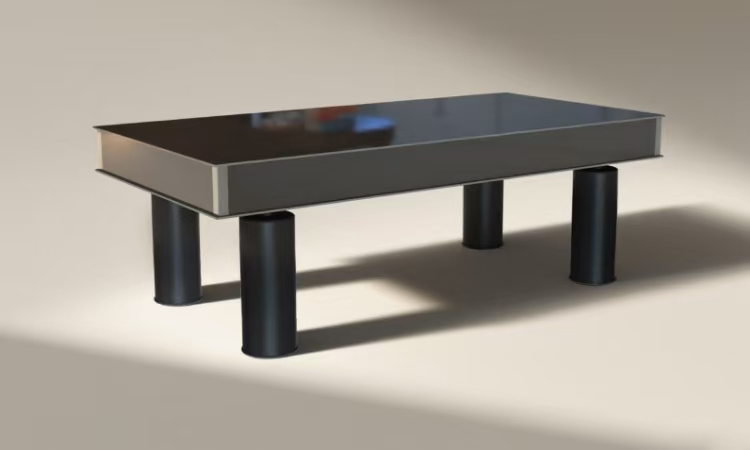
LeadTop's POT-G series hollow conical vibration isolation optical platform boasts vertical/horizontal natural frequencies as low as 4.0~8.0Hz. Coupled with a honeycomb tabletop, it effectively suppresses surface resonance. The tabletop features a flatness of 0.05-0.1mm/㎡ and a surface matte finish to reduce light reflection interference. It is suitable for high-precision equipment such as microscopes and laser scanning systems.
The future landscape of vibration isolation technology
With the escalating demand for precision manufacturing, vibration isolation systems are evolving towards intelligence, low-frequency performance, and integration. Brands like LeadTop, through innovative designs such as active control and composite vibration isolation structures, are providing comprehensive solutions for acoustic laboratories, semiconductor manufacturing, and other fields, propelling vibration isolation technology from "passive defense" to "active intelligence".


