LeadTop (立得泰隔振) designs, builds and installs vibration isolation platforms, with a particular strength in very large and non-standard platforms. Installation is where most isolation projects fail, so the delivery process is the product: a survey behind it, a torque record under it, an octave band spectrum after it. The same five stages run on a 200 kg bench and a 28 t platform.
Company background
The manufacturer is Nanchang Lideta Technology Co., Ltd., a high-tech enterprise working to ISO 9001, with 35 engineers and 23 technical specialists. More than 1000 users have taken delivery, and more than 150 projects needed a custom solution.
|
Company fact |
Detail |
Why a buyer should care |
|
Legal entity |
Nanchang Lideta Technology Co., Ltd. |
Contract and warranty sit with a named manufacturer |
|
Quality system |
ISO 9001 |
Process control on welding, machining, assembly |
|
Engineering capacity |
35 engineers, 23 technical specialists |
Frames designed in house, not outsourced |
|
Installed base |
More than 1000 users |
Repeat projects in universities and industry |
|
Custom record |
More than 150 custom solutions |
Non-standard sizes are routine |
The custom record changes outcomes. A platform 3.5 m long, a layout around an off-centre column, or a frame that has to pass a 1.2 m door is a design problem before it is a product problem.
The five delivery stages
|
Stage |
What happens |
Deliverable |
Who signs |
|
1. Survey and specification |
Floor flatness, load capacity, 1 to 80 Hz baseline, acoustic background |
Survey report with octave band data and a VC target |
Facility engineer and LeadTop |
|
2. Design and analysis |
Support layout against centre of gravity, frame stiffness, anchor detail |
General arrangement drawing, torque table |
Project engineer |
|
3. Manufacture and test |
Welding, machining, flatness check, load test |
Flatness record at 0.05 to 0.1 mm/m² |
Quality department |
|
4. Site installation |
Marking, drilling, anchoring, leveling, air connection |
Installation record with per-bolt torque |
Site supervisor |
|
5. Acceptance and handover |
Three-axis measurement, 1/3 octave transmissibility |
Acceptance report, level record, service schedule |
User and installer |
Stages 1 and 5 are the two clients under-budget. A survey costs a day and prevents a wrong isolator; an acceptance test settles an argument that otherwise runs for months.
Product lines and where each one installs
|
Series |
Type |
Key parameters |
Installation requirement |
|
Pneumatic optical table |
1.0 to 2.0 Hz, 95 percent efficiency, auto-leveling ±10 mm |
Dry air at 0.4 to 0.6 MPa |
|
|
Pneumatic pendulum |
1.0 to 1.5 Hz horizontal, 99 percent efficiency |
Dry air, plumb piston |
|
|
POT-P and POT-G |
Solid and conical rubber |
6.5 to 12 Hz and 4.0 to 8.0 Hz |
Flat floor, shim pack, no air |
|
POT-C |
Vehicle-mounted platform |
3.0 to 5.0 Hz horizontal, three-stage protection, ±10 mm |
No floor fixing, castors |
|
VCM and TA series |
Active bars and desktop tables |
1 to 200 Hz, six degrees of freedom, 95 percent at 10 Hz |
Power and controller space |
|
Heavy duty for TEM and SEM |
0.5 to 200 Hz, four-stage air spring at 1.5 Hz or lower |
Structural interface, air |
|
|
LHV |
Active isolation module |
0.5 to 20 Hz, −30 dB or better, 0.5 to 5 t |
Load-rated frame interface |
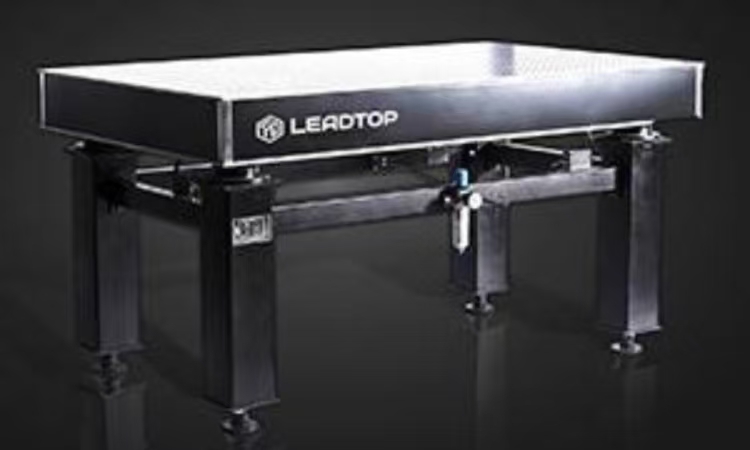
The last column decides most projects: it describes what the site must provide, not what the platform can do.
What the installed base looks like
|
Project |
Configuration |
Measured result |
|
Changchun institute, ZDT-P350 |
Four QF350 isolators, 1930 × 1480 mm spacing, ±80 mm rod stroke |
Below 1.5 Hz vertical, ±0.1 mm auto-level repeatability, 4.2 t load |
|
Nanjing company, ZDT-P250 |
Four isolators at 3500 × 2100 mm spacing, 1965 mm height |
Below 2.0 Hz, 930 kg platform with a 2.5 t instrument |
|
Wuhan company, ZDT-P500 |
Eight isolators at 1200 mm height |
1.5 Hz horizontal or lower, 82 to 88 percent at 5 Hz, 28 t capacity |
|
Shanghai company, hybrid base |
2.12 × 1.65 × 0.3 m welded base, 27 M12 leveling bolts |
Active platform isolated inside a rigid frame |
The Wuhan project shows what very large means: eight isolators, 28 t capacity, an acceptance criterion written in octave bands rather than adjectives.
Honest positioning against Newport and Herzan
|
Dimension |
Newport |
Herzan |
LeadTop |
|
Catalogue breadth |
Broad optical range, global distribution |
Active isolation and enclosures |
Narrower catalogue, deeper custom work |
|
Standard lead time |
Short for catalogue items |
Project dependent |
Quoted per project |
|
Very large platforms |
Less common in the reference base |
Less common in the reference base |
Core strength, 150+ custom |
|
Installation model |
Distributor or integrator |
Application engineering plus partners |
Own engineers, survey to acceptance |
|
Standards |
International, VC criteria |
International, VC criteria |
GB 50868 and IEST-RP-CC012 both routine |
Newport is the natural choice for a standard table from stock, and Herzan fits projects centred on active cancellation and enclosures. LeadTop fits when the platform is large, non-standard, or goes into a building where the floor is unknown.
Contact
Nanchang Lideta Technology Co., Ltd. (LeadTop)
Room 1010, Mingzhu Guang Business Building, No. 49 Jiefang West Road, Qingyunpu District, Nanchang, Jiangxi, China
Telephone: +86 791 88224425
Website: https://www.opticaltable.cn
FAQ
Does LeadTop install platforms it did not manufacture?
Yes, subject to a survey. Retrofits under existing frames are common, and the survey decides whether the frame has the stiffness and height. The acceptance criterion is agreed first.
Who carries out the site work?
LeadTop's own engineers, which keeps survey, anchor detail and acceptance under one responsibility. Partners handle lifting and civil work, but the isolation decisions stay with the manufacturer.
What happens if the acceptance test fails?
The octave band data shows which band failed, so the cause is usually identifiable on the day: a bridged pipe, a lock still engaged, or floor resonance below the isolator frequency.
Is a custom platform more expensive than a standard one?
It depends on the frame and isolator count, not the word custom. A platform that fits the room often costs less than a standard frame plus site modifications.
Which standard is used for acceptance in China?
GB 50868 for the design code, IEST-RP-CC012 for the criteria and ISO 10817 for measurement. Reporting to all three keeps it usable for domestic and international reviewers.
Can the same team maintain the platform after handover?
Yes. Handover includes a level record and a service schedule; the annual check covers level, air quality, restraint gaps and anchor torque, so drift is caught early.


