On the surface, an optical table appears as nothing more than a gray platform with a dense array of threaded holes. But across the precision experiments of different scientific disciplines, the role played by an optical table is far more complex than that of a mere desk—it is the stable coordinate system shared by the reference arm and measurement arm of an interferometer, the vibration-free sanctuary where holographic film records micron-scale interference patterns, and the mechanical guarantee for nanometer-scale focal-point positioning of femtosecond lasers within processing windows tens of microns wide.
Different application scenarios place different emphases on optical table performance requirements. This article focuses on five major fields—laser interferometry, holographic imaging, semiconductor inspection, ultra-precision machining, and biomedical imaging—systematically analyzing the specific technical conditions an optical table must satisfy in each scenario, using the ZDT-P series pneumatic vibration isolation optical table as a concrete example to demonstrate how a well-designed optical table delivers on its performance promises under real experimental conditions.
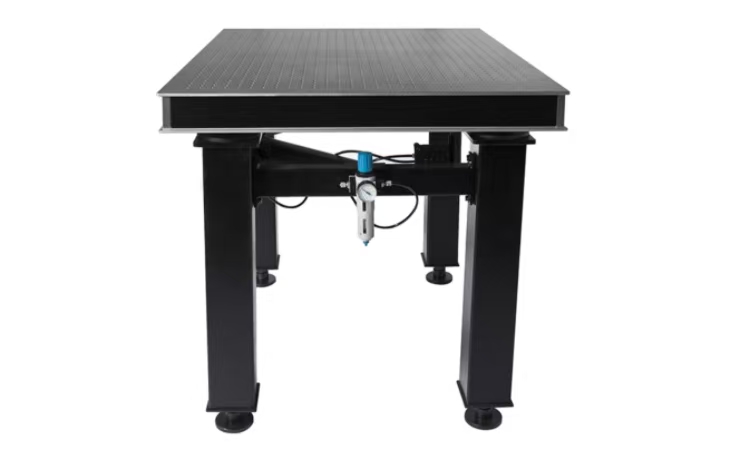
Laser interferometric measurements—whether a Twyman-Green interferometer for optical component surface figure testing or a Mach-Zehnder interferometer for refractive index measurement—rank among the most demanding vibration isolation requirements for optical tables across all optical experiments.
Taking mirror surface figure testing as an example: both the reference flat and the test optic are mounted on the same optical table, and the relative orientation accuracy required between them reaches the sub-wavelength level. If the optical table undergoes micrometer-scale elastic deformation during measurement due to building vibration, the optical path difference between the reference mirror and the test mirror will be contaminated by the deformation noise of the optical table itself—at which point what the interferometer measures is not the mirror surface figure error, but a mixed signal of mirror error plus optical table deformation.
The ZDT-P series optical table achieves isolation efficiency of up to 95%, with the pneumatic system controlling the natural frequency within the 1.0–2.0 Hz range, ensuring that the majority of building vibration energy is attenuated layer by layer through the air springs and multi-orifice quasi-laminar damping before reaching the tabletop. In the highest-precision scenario of laser interferometry, the isolation performance of the optical table is not merely a bonus—it is the direct criterion for the validity of interferometric data.
The recording principle of holographic imaging involves permanently fixing the interference fringes formed by the object beam and the reference beam on a photosensitive medium, with these interference fringe spacings typically on the order of microns or even sub-microns.
During exposure periods lasting from several seconds to several minutes, any micro-vibration on the optical table exceeding one-quarter of the laser wavelength (approximately 158 nm for a 632 nm He-Ne laser) will cause irreversible blurring of the interference fringes on the photosensitive medium, resulting in a sharp decline in the diffraction efficiency of the entire hologram.
This imposes an almost exacting requirement on the optical table: it must not only maintain stillness throughout the entire exposure period, but also possess the rapid stabilization recovery capability to cope with intermittent transient vibrations arising from events such as air conditioner startups and elevator operation in the building environment.
The ZDT-P series' multi-orifice quasi-laminar damping exhibits a unique advantage in holographic imaging scenarios: laminar damping rapidly dissipates vibration energy in an orderly manner, avoiding the secondary micro-vibrations that turbulent damping could potentially produce—this enables the optical table to return to its static baseline in an extremely short time after experiencing a transient disturbance, ensuring the integrity and repeatability of holographic exposure data.
The performance requirements that CD-SEM (critical dimension scanning electron microscopy) and electron beam defect inspection systems in semiconductor manufacturing impose on optical tables are fundamentally different from those of research laboratories. In semiconductor production lines, vacuum pump sets, overhead transport systems, and the high-frequency RF conditions of etch tools collectively create a round-the-clock, broadband, continuously varying composite vibration environment. What the optical table must provide in the production line is no longer the isolation performance under best-case conditions, but rather consistent isolation effectiveness that remains unchanged regardless of fluctuations in the factory environment during continuous 7×24 operation.
The ZDT-P's pneumatic automatic leveling function holds special practical value in production line environments: the concrete floors of semiconductor fabs may experience sub-millimeter micro-settlement over extended periods of equipment operation, and manual periodic leveling is often difficult to enforce rigorously under the tight production schedules of the fab. Pneumatic automatic leveling enables the optical table to autonomously maintain itself after installation without human intervention, automatically compensating the height of each support leg when micro-settlement occurs and preserving the level reference state of the optical table over the long term.
Ultra-precision processing technologies such as femtosecond laser micro/nano fabrication and single-point diamond turning demand the highest level of optical table stability encountered in practical industrial applications. In femtosecond laser processing, the laser focus scans across the sample surface in a raster pattern with micron-scale precision; if the optical table surface undergoes micron-scale vibration during processing, the processing pattern will exhibit visually discernible misalignment between different scan lines—which, for the functional realization of microfluidic chips, diffractive optical elements, and other micro/nano devices, can be catastrophic.
A second challenge for optical tables in ultra-precision processing is thermal stability: the localized thermal effects during laser processing and the heat generated by the processing machine's motor operation may cause uneven temperature distribution across the optical table tabletop and induce localized deformation. The ZDT-P's pneumatic system generates virtually no heat during operation (air springs operate without frictional heating), and its tabletop flatness is controlled at 0.05–0.1 mm/m², providing the dual guarantee of thermal stability and geometric stability for ultra-precision processing machines.
During the development phase of biomedical optical devices such as OCT (optical coherence tomography) and confocal microscopic imaging systems, the optical table is an indispensable experimental platform for system integration and performance verification. The reference arm and sample arm optical paths of an OCT system require precise common-path alignment on the optical table; any micro-vibration of the platform will directly translate into inter-layer artifacts in retinal tomographic images—which is completely unacceptable in the performance verification of clinical-grade imaging equipment.
Furthermore, medical device development typically involves cross-disciplinary team collaboration and repetitive optical path alignment procedures; the pneumatic automatic leveling function reduces the manual leveling time required during each experimental preparation phase, significantly enhancing R&D efficiency.
The quiet air compressor (below 50 dB) of the LeadTop ZDT-P series optical table ensures a comfortable working environment for operators during extended development experiments, while the matte tabletop surface prevents stray light interference from high-power probe light sources on the optical table. As a supplier of vibration isolation optical platforms and accessories, LeadTop provides optical table solutions for medical optical device R&D teams that balance precision isolation performance with long-term usability.
From nanometer-scale surface figure measurement in laser interferometers to sub-wavelength recording precision in holographic imaging, from 7×24 continuous operation in semiconductor production lines to micron-scale focus control in ultra-precision machining—the optical table consistently serves, in its role as a silent foundation, every frontier of precision science. A truly excellent optical table solution does not pursue the extreme of any single specification on a datasheet, but rather finds the optimal balance among isolation depth, reference precision, degree of automation, and long-term reliability—a balance that is precisely matched to the specific application scenario.
We hope this in-depth analysis of five major application fields provides researchers and engineers evaluating optical table solutions with engineering insights of practical reference value.


