In any optics laboratory, there exists a category of foundational components that are both ubiquitous and underappreciated—optical breadboards. Defined simply, an optical breadboard is a flat plate densely populated with a grid of threaded holes, providing a unified mounting reference for lasers, mirrors, beam splitters, lenses, and detectors. Unlike large-scale pneumatic optical tables, optical breadboards offer greater dimensional flexibility and deployment convenience, making them widely used in benchtop optical experiments, precision optical inspection, and educational settings.
However, when selecting an optical breadboard, many users focus solely on the thread-hole specification and overall dimensions, while overlooking the core technical indicators that determine long-term stability—such as the faceplate material, honeycomb core structure, flatness, and deformation. This article systematically examines the technical content and selection logic of optical breadboards from three perspectives: structural principles, key parameters, and application-specific selection advice.
A high-quality optical breadboard is far more than a metal plate with holes drilled into it. Taking the honeycomb-core structure as an example, its interior is a precision multilayer composite: the top layer is a high-permeability stainless steel faceplate (typically 430-grade), the middle layer is a honeycomb core plate, and the bottom layer is likewise clad with a stainless steel faceplate. Embedded between the top and bottom faceplates are isolation cups—when a user threads a screw into a faceplate hole, the isolation cup prevents the screw tip from penetrating through the breadboard and damaging the bottom faceplate’s sealing integrity and overall rigidity.
This sandwich construction derives from the mature lightweight sandwich panel technology used in the aerospace industry: the honeycomb core occupies only about 3–5% of the total volume but delivers exceptional specific stiffness and outstanding bending resistance. Compared to a solid steel plate of equal thickness, a honeycomb-core optical breadboard can reduce weight by 60–70% while retaining over 90% of the stiffness. The weight advantage is particularly apparent in scenarios requiring frequent experimental reconfiguration—a 600 mm × 600 mm honeycomb-core optical breadboard can be easily lifted and repositioned by a single researcher.
The faceplate material of an optical breadboard is the first key variable affecting long-term use quality. Two major categories exist on the market: carbon steel faceplates (a low-cost option) and stainless steel faceplates (a mid-to-high-end option). The primary drawback of carbon steel is its rust resistance—optical laboratories tend to operate at elevated humidity levels, and micro-leakage from laser cooling water systems, combined with solvent vapors released during optical component cleaning, can accelerate rust formation on carbon steel surfaces.
Once rust develops inside a threaded hole, not only does screw installation and removal become difficult, but rust particles may also contaminate the optical coatings on precision components.
In contrast, 430 high-permeability stainless steel offers three key advantages: first, its chromium content of approximately 16–18% provides rust resistance far superior to carbon steel under normal laboratory conditions; second, as a ferritic stainless steel, 430 retains magnetic permeability—a practical feature when magnetic bases are needed for optical component mounting; and third, its dense, smooth surface allows easy daily cleaning with a lint-free cloth and alcohol.
As a supplier of vibration isolation optical tables and accessories, LeadTop’s adoption of 430 high-permeability stainless steel faceplates on its MOT-F series honeycomb-core optical platform plates reflects a deep understanding of the full-lifecycle material performance required in optical laboratories.
When selecting an optical breadboard, the following three specifications serve as the core criteria for determining its precision grade.
The first is flatness. As the reference plane for optical path construction, an optical breadboard’s surface irregularities directly cause optical components at different locations to reside in different height coordinate systems—for precision systems such as interferometers that are sensitive to optical path coplanarity, this height deviation is a direct source of systematic error. Research-grade optical breadboards should control flatness within 0.05–0.1 mm/m², which is precisely the range in which the MOT-F series operates.
The second is deformation, a dynamic metric measuring an optical breadboard’s geometric stability over long-term use. All metallic materials contain residual stress after processing; over time and with temperature cycling, this stress slowly relaxes, potentially causing micro-deformation of the breadboard. A deformation value below 2 µm/m² means that even under year-after-year thermal cycling, the breadboard’s geometry remains virtually unchanged—a specification with significant practical value for batch inspection stations requiring long-term optical path alignment precision.
The third is faceplate material and surface finish. As discussed, 430 stainless steel faceplates outperform carbon steel in rust resistance, magnetic permeability, and ease of cleaning. For environments involving acid mist or salt spray, 316L stainless steel faceplates or Teflon coating treatments may be considered.
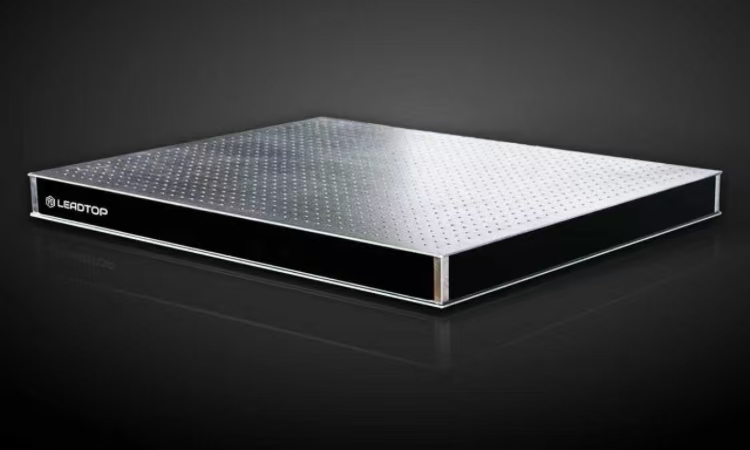
The LeadTop MOT-F series honeycomb-core optical platform plate is a representative technical product in the current market. Its structure is a honeycomb hollow design, precision-laminated from four components: top faceplate, bottom faceplate, isolation cups, and a honeycomb core plate.
Among these, the isolation cup is an easily overlooked yet ingeniously engineered feature—beneath each threaded hole sits an independent metal isolation cup, so that when a user threads an M6 or M4 screw into the faceplate’s threaded hole, the screw tip stops inside the cup without penetrating to the bottom. This design not only protects the integrity of the breadboard’s bottom faceplate but also prevents compressive damage to the honeycomb core layer from over-tightened screws.
The tabletop surface features an evenly spaced grid of threaded holes—the common pitch for M6 holes is 25 mm (approximately 1 inch) or 50 mm, with some high-density models offering supplementary M4 holes at a 12.5 mm pitch to accommodate different types of standard optical mounts and post systems. Flatness is strictly controlled within the 0.05–0.1 mm/m² range, with deformation below 2 µm/m², ensuring that the breadboard remains free of long-term distortion—this set of specifications makes the MOT-F series particularly well-suited to optical experiments and precision inspection applications that demand high levels of cleanliness and stability.
Optical breadboards play different roles in different experimental contexts. In university optics teaching laboratories, an optical breadboard is typically placed directly on a standard lab bench, serving as a practice platform where students build basic optical paths—a 300 mm × 450 mm or 450 mm × 600 mm entry-level optical breadboard suffices. In precision optical inspection stations, optical breadboards are often paired with compact isolation stands or rubber isolation pads to construct benchtop-level vibration-isolated optical platforms—this low-cost combination of breadboard plus isolation support is widely adopted in batch inspection scenarios.
In ultrafast laser laboratories, multiple optical breadboards may be joined into a large-area optical plane, with precision locating pins ensuring horizontal alignment between adjacent breadboards, creating a modular and reconfigurable optical path infrastructure. The guiding principle for pairing optical breadboards and optical tables is: if the experiment demands high vibration isolation (e.g., interferometry), prioritize investment in the optical table itself; if the experiment places a higher premium on layout flexibility and cost control, the superior cost-effectiveness and multi-size adaptability of optical breadboards represent an irreplaceable advantage.
Beneath their deceptively simple appearance, optical breadboards shoulder the critical yet unglamorous mission of serving as the reference foundation for precision optical experiments. From the lightweight honeycomb core to the long-term rust resistance of 430 stainless steel faceplates, from the ingenious protection of isolation cups to micron-level deformation control—only by truly understanding the engineering considerations behind a high-quality optical breadboard can one select correctly and invest wisely.
We hope this article’s systematic examination of optical breadboard structures, specifications, and application scenarios provides optical laboratory builders and users with a practical selection reference.


