Across the broad landscape of modern scientific research, precision optical experiments span the full range from investigations of the microscopic nanoworld to telescopic observations of the distant cosmos. Behind every one of these high-precision experimental systems, an unassuming yet absolutely critical component works silently in the background — the optical table.
A high-performance optical table functions as the stabilizing anchor of the entire experimental apparatus, continuously absorbing micro-vibrations transmitted from the ground and surrounding environment, providing an ultra-stable working plane for sensitive instruments.
Simply stated, without quality optical tables, reliable precision experimental data cannot be obtained, and optical tables are the unsung heroes of every successful precision measurement campaign. This article examines the application of optical tables across five critical research domains, highlighting the foundational role that optical tables play in advancing contemporary science and technology.
Laser interferometers are universally recognized as among the most precise tools available for measuring length, displacement, and surface topography, capable of achieving sub-nanometer measurement resolution under optimal operating conditions. When operating at this extreme level of precision, any microscopic vibration — imperceptible to human senses — can cause visible fringe jitter and drift in the interferometer output, severely compromising the credibility and repeatability of measurement results.
Mounting the complete laser interferometry system on an optical table with superior vibration isolation performance is an absolute prerequisite for stable operation and reliable data. Pneumatic optical tables offer irreplaceable advantages in ultra-precision applications: their 99% isolation efficiency enables laser interferometers to fully realize their measurement potential.
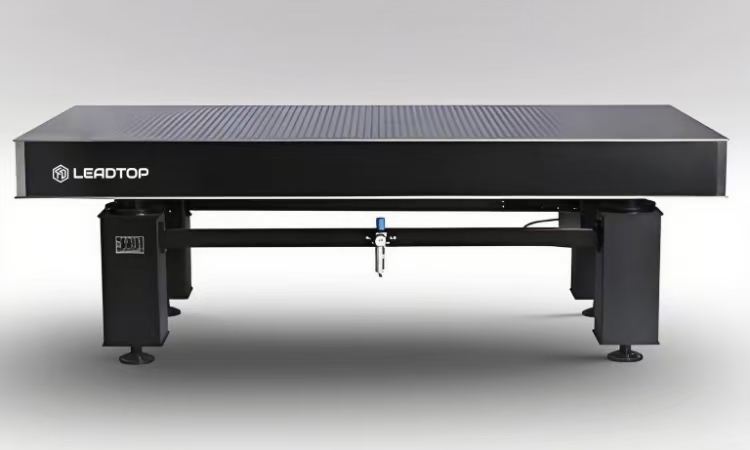
Taking the LeadTop ZDT-B series pneumatic pendulum-type optical table as an example, this high-performance optical table features ultra-low natural frequency design and precise automatic leveling functionality, providing a near-ideal equipment mounting environment for laser interferometry and setting a benchmark for optical tables in this demanding field.
Modern microscopy has decisively broken through the classical optical diffraction limit — techniques including confocal, STED, SIM, and single-molecule localization microscopy all impose unprecedented demands on mechanical system stability.
During long-duration live-cell dynamic imaging, minute vibrations of the optical table are magnified tens of thousands of times by the microscope optics, directly manifesting as image blur, focal drift, and degraded resolution. Mounting expensive high-end microscope systems on a high-performance optical table fundamentally suppresses the effects of environmental vibration on image quality from the source.
The high structural stiffness and excellent damping characteristics inherent to quality optical tables ensure that the focal plane remains precisely locked throughout experiments lasting many hours. This level of stability that a well-engineered optical table provides enables researchers to acquire clear, stable, and reproducible super-resolution image data—an invaluable capability for cutting-edge research in the life sciences and materials science, where the optical table truly serves as the unsung foundation of every successful imaging campaign.
The semiconductor industry operates at the most demanding levels of manufacturing precision in the modern industrial world. During both R&D and volume production of advanced process nodes, critical operations such as wafer defect inspection, lithographic overlay alignment, and thin-film thickness metrology impose extraordinarily stringent requirements on environmental vibration levels.
Modern semiconductor metrology tools must perform precise positioning and quantitative analysis at sub-micron scales, and optical tables serve as the indispensable stable platform in these contexts. The role of optical tables in the semiconductor domain is concentrated primarily in R&D settings — probe stations, ellipsometers, and thin-film stress measurement systems all demand high levels of flatness and vibration isolation.
Optical tables designed with proper material selection also meet the additional technical challenges posed by cleanroom environments, where the quality of the optical table directly impacts measurement yield and process control.
Quantum optics and quantum information science rank among the most active and closely watched frontier domains in contemporary physics research.
In experiments involving spontaneous parametric down-conversion entangled photon source construction, precise single-photon state manipulation, quantum teleportation, and quantum key distribution, the long-term stability of the optical system bears a direct and fundamental causal relationship with the fidelity of the quantum states under investigation.
These advanced quantum experiments routinely demand that optical systems maintain sub-wavelength alignment precision over continuous operation periods spanning many hours or even several consecutive days, imposing exceptionally rigorous long-term stability requirements on the optical tables serving as the system foundation. Pneumatic optical tables, with their demonstrated insensitivity to ambient temperature fluctuations and their sustained, stable isolation performance output, have become standard equipment in quantum optics laboratories worldwide, providing essential physical support as quantum technologies advance from laboratory demonstrations toward practical real-world applications. In this rapidly evolving field, optical tables are not merely passive platforms but active enablers of breakthrough discoveries.
Within the aerospace technology sector, critical tasks such as high-precision star tracker calibration, ground-based performance verification of space-borne optical remote sensing payloads, and surface figure metrology of large-aperture aspheric mirrors all impose extremely demanding standards on the environmental stability of testing platforms.
These large-scale precision testing systems typically involve the precision integration and alignment of optical components distributed across multiple subsystems, where any micro-scale relative displacement can produce unacceptable aggregate measurement errors. The deployment of large-format custom optical tables paired with high-reliability vibration isolation solutions can provide decades of stable physical support for aerospace-grade precision optical testing.
Choosing the right optical tables for such demanding applications requires careful evaluation. In this high-stakes domain, selecting an optical table supplier with extensive customization experience is critically important. LeadTop, as a professional brand in vibration-isolation optical tables and accessory products, leverages substantial project experience to offer comprehensive optical table solutions spanning from standard optical table configurations to large-format custom optical tables tailored to mission-specific requirements.
From precision measurements in fundamental physics research to in-line inspection in advanced industrial manufacturing, optical tables—through their irreplaceable vibration isolation and stable load-bearing performance—continuously underpin the precision-driven advancement of modern science. Behind every optical table that has been thoughtfully designed lies deep technical wisdom drawn from materials science, mechanical engineering, and precision machining.
As scientific exploration pushes relentlessly toward ever-smaller scales and ever-greater precision, the strategic importance of optical tables as foundational infrastructure for precision experimentation will only grow.
Choosing the right optical tables is tantamount to establishing the most solid physical foundation for a laboratory's core competitiveness, and every experienced researcher knows that premium optical tables represent a long-term investment in data quality and experimental reproducibility—not a mere equipment expense, but the very bedrock upon which all reliable precision measurements depend.


