Navigating the wide variety of vibration isolation products on the market to identify the right rubber vibration isolators for a given application poses a challenge shared by engineering procurement professionals and technical decision-makers alike. The quality of rubber vibration isolators directly determines the effectiveness of the entire vibration isolation system—incorrect selection not only wastes investment capital but may lead to equipment damage or experimental data distortion resulting from inadequate vibration control. This article systematically outlines critical considerations for selecting rubber vibration isolators across four dimensions: application scenario analysis, technical specification evaluation, brand and service assessment, and overall cost-effectiveness.
Define Your Needs for Rubber Vibration Isolators
The first step in selecting rubber vibration isolators is a clear definition of the specific working conditions they must serve. Different application scenarios impose markedly different requirements: laboratory environments prioritize isolation precision and long-term stability, while industrial workshops demand enhanced environmental resilience and fatigue resistance under harsh operating conditions. Key information to gather includes the total weight and geometric dimensions of the equipment to be isolated, the vibration-sensitive frequency range, the primary types of vibration sources at the installation site—such as ground traffic vibrations, building wind-induced vibrations, or adjacent operating machinery—and the ambient temperature and humidity conditions. A well-defined and complete set of scenario requirements forms the essential foundation for ensuring that rubber vibration isolators deliver their expected isolation performance in actual service.
Evaluate Technical Specifications of Rubber Vibration Isolators
Once the application scenario is fully defined, the technical parameters of candidate rubber vibration isolators must be reviewed item by item with rigorous scrutiny. Natural frequency is the highest-priority specification: the required value should be derived from the dominant vibration frequencies at the site to ensure the target frequency band falls squarely within the effective isolation zone. The damping ratio is directly linked to resonance-zone safety, and rubber vibration isolators should generally maintain a damping ratio no lower than 0.05. Load capacity requires an explicit safety margin—it is recommended that the actual service load never exceed 80% of the rated capacity to accommodate dynamic load fluctuations. Additionally, evaluate the rubber material's aging resistance, the temperature stability of stiffness characteristics, and the lateral structural stability of the isolator: high-quality rubber vibration isolators must deliver reliable isolation performance simultaneously in both horizontal and vertical directions across their designed service life.
Assess Brands and Service for Rubber Vibration Isolators
Product quality is intimately tied to the supplier's technical capabilities and commitment to quality. When evaluating brands, consider whether the supplier possesses genuine independent R&D and manufacturing capability, whether technical documentation and performance test reports are comprehensive, standardized, and independently verifiable, and whether customized rubber vibration isolators can be designed and produced for specific user requirements and non-standard application scenarios. Quality brands further distinguish themselves by offering thorough pre-sales technical consultation and attentive post-sales installation guidance—both of which are critically important for correct deployment and long-term reliable operation. Market application case studies and sustained industry reputation also serve as valuable indicators: a track record of extensive successful real-world deployments generally signals a mature and dependable product line of rubber vibration isolators backed by engineering experience.
Cost-Effective Rubber Vibration Isolators from LeadTop
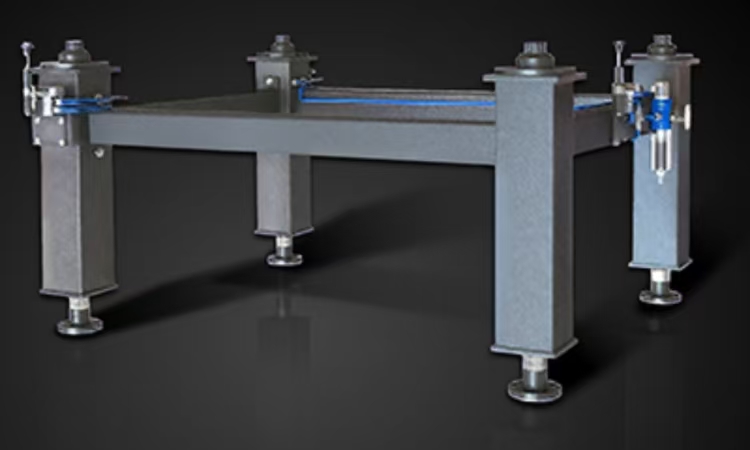
In the balance between performance and cost, consider the POT-P series solid rubber vibration isolators from LeadTop, a professional supplier of vibration isolation optical platforms and accessories. These rubber vibration isolators employ a composite rubber structure design, delivering vertical natural frequencies of 6.5–12 Hz, horizontal natural frequencies of 3–8 Hz, a damping ratio of 0.05–0.2, and load coverage of 180–800 kg per unit, with recovery time under five seconds. The stable, compact construction enables efficient installation, while integrated lifting adjustment mounts provide precise leveling capability—optional casters are also available for applications requiring equipment mobility. The POT-P series rubber vibration isolators have accumulated strong and verified application experience in microscopy and medical-biological testing, presenting users with a quality choice that effectively balances technical performance with economic efficiency.
Selecting high-performance rubber vibration isolators is a systematic engineering task involving careful trade-offs across technical specifications, application context, supplier evaluation, and budget constraints. By following the structured selection framework developed in this article—from thorough scenario definition through meticulous specification evaluation and from rigorous brand assessment to a balanced final procurement decision—users can significantly improve both procurement efficiency and selection accuracy. In an era of relentlessly advancing precision technology, choosing quality-assured, performance-matched rubber vibration isolators establishes a solid and durable foundation for the long-term reliable operation of precision equipment across the full spectrum of scientific and industrial settings.


